
10 Best Agile Project Management Tools in 2026
If you are choosing an agile project management tool in 2026, the right answer depends less on a giant feature checklist and more on the workflow you run every week. Software teams care about sprint planning, backlog structure, GitHub-connected delivery, and release visibility. Agencies care about time tracking, client reporting, and predictable handoffs. IT operations teams care about changes, incidents, and reporting that works outside engineering.
The strongest tools in this market do different jobs well. Jira still sets the standard for deeply standardized software organizations. Asana and monday.com are strong for cross-functional work management. Teamwork is purpose-built for client service delivery. Linear is excellent for fast-moving product teams. Azure DevOps is still a serious option if your engineering stack lives in Microsoft. And if you want project delivery, reporting, time, files, and adjacent operational workflows in one operating layer, Scrumbuiss belongs on the shortlist.
This guide is written for teams comparing real buyers' tradeoffs, not just reading vendor taglines. Every recommendation below is based on official vendor pricing and product pages reviewed on March 12, 2026, plus the fit questions that usually decide whether a tool becomes part of your operating system or just another layer in the stack.
Key Takeaways
- Jira remains a strong default for engineering teams already standardized on Atlassian, but it is not automatically the best fit for agencies, IT operations, or mixed stakeholder reporting.
- Teams that need agile planning plus adjacent workflows such as time tracking, client delivery, or change coordination should evaluate the stack around the tool, not just the board itself.
- The fastest way to choose well is to test one weekly workflow end to end: sprint planning, delivery review, client handoff, or change coordination.
How We Evaluated These Tools
This guide was reviewed on March 12, 2026.
Each tool was evaluated against the same criteria:
- Sprint and backlog support
- Reporting visibility for leads and stakeholders
- Capacity and timeline planning
- Integrations and automation depth
- Admin overhead and maintainability
- Pricing clarity
- Team fit for software teams, agencies, IT operations, and small cross-functional groups
The official pages reviewed for this comparison:
- Jira pricing and Jira features
- Asana pricing
- ClickUp pricing
- monday.com pricing
- Trello pricing
- Wrike pricing
- Teamwork pricing
- Linear pricing
- Azure DevOps pricing
- Scrumbuiss pricing, Project Delivery, and Software teams workflow
Vendor packaging changes often. Use the notes below to narrow the shortlist, then verify your exact seat count and add-on costs before making a final purchase.
Quick Comparison Table
| Tool | Best for | Strongest advantage | Main tradeoff | Pricing model |
|---|---|---|---|---|
| Jira | Standardized software teams | Deep Atlassian ecosystem and issue tracking depth | More admin overhead than lighter tools | Free + paid Standard/Premium/Enterprise tiers |
| Asana | Cross-functional teams | Strong workflow clarity and stakeholder reporting | Less software-delivery-native than Jira or Azure DevOps | Free; paid Starter/Advanced; Enterprise custom |
| ClickUp | Teams wanting all-in-one flexibility | Broad feature depth at a low entry price | Can become configuration-heavy fast | Free; Unlimited $7; Business $12; Enterprise custom |
| monday.com | Teams that want flexible board/database workflows | Dashboards, automations, and easy process shaping | Advanced work management depth rises with tier cost | Free; Basic EUR 9; Standard EUR 12; Pro EUR 19; Enterprise custom |
| Trello | Small teams starting with simple boards | Fastest setup and lowest friction | Limited once you need richer planning and reporting | Free; Standard $5; Premium $10; Enterprise from $17.50 |
| Wrike | Operations teams and PMOs | Configurable work views and enterprise controls | Heavier experience than lighter agile tools | Team $10; Business $25; Enterprise custom |
| Teamwork | Agencies and client service teams | Client work, time, budgeting, and profitability focus | Less natural for engineering-led product delivery | Deliver $10.99; Grow $19.99; Scale custom |
| Linear | Product and engineering teams | Fast, opinionated, low-friction issue tracking | Lighter for agencies, IT ops, and broad stakeholder reporting | Free; Basic $10; Business $16; Enterprise custom |
| Azure DevOps | Microsoft-centric engineering teams | Boards, repos, pipelines, and test plans in one stack | Less friendly for non-engineering stakeholders | First 5 users free; Basic $6; Test Plans $52 |
| Scrumbuiss | Teams that want one delivery operating layer | Agile delivery plus reporting, time, files, and adjacent workflows | Smaller ecosystem than the largest incumbents | 14-day trial; Team $9/$7 annual; Business $17/$14 annual |
Detailed Comparison
Use these sections to match the tool to the team shape, not just the feature list.
Jira
- Best for: Engineering organizations already standardized on Atlassian and willing to invest in deeper workflow administration.
- Strengths: Jira is still one of the strongest tools for backlog structure, sprint planning, issue tracking, permissions, and ecosystem breadth. If your workflows already depend on Atlassian standards, it is hard to ignore.
- Limits: The tradeoff is operating overhead. Once capacity planning, stakeholder-friendly reporting, IT operations, and adjacent workflows spread across multiple tools, the stack can become heavier to govern.
- Pricing note: Atlassian's public pricing page lists a Free tier for up to 10 users plus Standard, Premium, and Enterprise tiers that scale by seat count. Recheck the official pricing calculator for your exact team size.
- Why it made the list: Jira is still a serious default for software delivery, and it is the benchmark many teams should compare against. If Jira is already on your shortlist, the useful next step is not another generic alternatives list but a workflow-level evaluation like this Scrumbuiss vs Jira guide.
Asana
- Best for: Cross-functional teams that need clear ownership, accessible reporting, and cleaner collaboration outside engineering.
- Strengths: Asana is strong at task structure, project views, approvals, and stakeholder visibility. It is often easier for mixed teams to adopt than engineering-first tools.
- Limits: It is not as software-delivery-native as Jira, Linear, or Azure DevOps. Teams that need deep sprint conventions, issue hierarchies, or engineering-specific workflows may outgrow the default setup.
- Pricing note: On the public pricing page reviewed on March 12, 2026, Asana lists Personal as free, Starter from $10.99 per user per month billed annually, Advanced from $24.99, and Enterprise tiers on custom pricing via the official pricing page.
- Why it made the list: Asana remains a strong option when agile delivery lives inside a broader cross-functional operating model. If you need to compare that against agency delivery, client work, and adjacent reporting needs, use this focused Scrumbuiss vs Asana comparison.
ClickUp
- Best for: Teams that want one highly flexible workspace for tasks, docs, dashboards, and automations without immediately moving into enterprise pricing.
- Strengths: ClickUp covers a lot in one product: multiple views, docs, goals, dashboards, time tracking, and broad customization. Its entry pricing is still aggressive relative to the amount of surface area you get.
- Limits: Breadth is also the risk. Teams can spend a lot of time shaping the workspace, and inconsistent configuration across teams can become its own maintenance problem.
- Pricing note: The public pricing page reviewed on March 12, 2026 lists Free Forever, Unlimited from $7 per user per month, Business from $12, and Enterprise on custom pricing via ClickUp pricing.
- Why it made the list: ClickUp is still one of the strongest all-round contenders for teams that want flexibility first. It belongs on most shortlists because it sits between lightweight task tools and heavier enterprise stacks.
monday.com
- Best for: Teams that want a flexible board-and-database style work management tool with strong automations and dashboards.
- Strengths: monday.com makes it easy to shape workflows for different teams, visualize work in multiple ways, and build reporting that is approachable for non-specialists.
- Limits: Once you need deeper project governance, advanced planning, or more sophisticated delivery workflows, the clean setup can turn into a larger configuration project and the price climbs quickly by tier.
- Pricing note: The monday.com pricing page reviewed on March 12, 2026 lists Free, Basic from EUR 9, Standard from EUR 12, Pro from EUR 19 per seat per month billed annually, and Enterprise on custom pricing via monday.com pricing.
- Why it made the list: monday.com is one of the most common board-first choices for growing teams. If that is your starting point, compare it directly against a delivery-focused operating model in this Scrumbuiss vs monday.com guide.
Trello
- Best for: Small teams that want to start with a simple board and avoid heavy process overhead.
- Strengths: Trello is still the easiest way to get a team from nothing to visible work. Boards, cards, and Butler automation are familiar, lightweight, and fast to adopt.
- Limits: Trello is weakest once you need richer reporting, cross-team planning, more structured sprint workflows, or stronger stakeholder visibility than a board alone provides.
- Pricing note: Trello's pricing page reviewed on March 12, 2026 lists Free, Standard at $5 per user per month, Premium at $10, and Enterprise from $17.50 per user per month billed annually via Trello pricing.
- Why it made the list: Trello still matters because many teams start there. It is also one of the clearest examples of a tool that is great at one stage and often stretched past its natural limit. If that sounds familiar, read the practical Scrumbuiss vs Trello comparison.
Wrike
- Best for: Operations teams, PMOs, and larger organizations that need configurable work views, approval flows, and more enterprise-style control.
- Strengths: Wrike is strong in configurability, cross-team coordination, and work management structures that go beyond a simple agile board. It can support more operational rigor than lighter tools.
- Limits: It is not the cleanest choice when the buying priority is pure sprint speed or a simpler engineering workflow. For smaller teams it can feel heavier than necessary.
- Pricing note: Wrike's public pricing page reviewed on March 12, 2026 lists Team at $10 per user per month, Business at $25, and Enterprise/Pinnacle on custom pricing via Wrike pricing.
- Why it made the list: Wrike remains relevant for teams that care more about coordination and control than pure software-delivery specialization.
Teamwork
- Best for: Agencies, consultancies, and client service teams that need delivery visibility tied to time, budgets, and profitability.
- Strengths: Teamwork is unusually focused on client work economics. Time tracking, budgeting, invoicing-adjacent controls, workload planning, and client-facing delivery workflows are central to the product.
- Limits: It is less compelling for product engineering organizations that care more about code-linked delivery, backlog nuance, or internal software planning than client service operations.
- Pricing note: Teamwork's public pricing page reviewed on March 12, 2026 lists Deliver from $10.99 per user per month, Grow from $19.99, and Scale on custom pricing via Teamwork pricing.
- Why it made the list: Teamwork is one of the clearest agency-native tools in the category. If your team bills time, runs client projects, or needs better handoffs from planning to delivery, it deserves a direct comparison.
Linear
- Best for: Product and engineering teams that want fast issue tracking, clean planning rituals, and minimal workspace clutter.
- Strengths: Linear is opinionated in a good way. It is fast, focused, and strong at issues, cycles, projects, triage, and engineering execution without burying the team in endless configuration.
- Limits: That focus also narrows the fit. Linear is lighter for client delivery, IT operations, financial controls, and broader stakeholder reporting than tools built for multi-department workflows.
- Pricing note: Linear's pricing page reviewed on March 12, 2026 lists Free, Basic at $10 per user per month, Business at $16, and Enterprise on custom pricing via Linear pricing.
- Why it made the list: Linear is one of the best examples of a speed-first engineering tool. It belongs on the shortlist for product teams that care about focus and discipline over maximum configurability.
Azure DevOps
- Best for: Engineering teams already invested in Microsoft's development stack and looking for boards, repos, pipelines, and test plans in one system.
- Strengths: Azure DevOps still offers a strong engineering bundle when the team wants planning, code, CI/CD, and testing to live inside the same Microsoft ecosystem.
- Limits: It is less approachable for non-engineering stakeholders than tools designed for mixed audiences, and it is rarely the cleanest fit for agencies or lighter cross-functional teams.
- Pricing note: The Azure DevOps Services pricing page reviewed on March 12, 2026 lists the first 5 Basic users free, additional Basic users at $6 per user per month, and Basic + Test Plans at $52 via the official pricing page.
- Why it made the list: Azure DevOps still matters when the workflow lives close to code, pipelines, and Microsoft governance. It is not the most fashionable tool in the category, but it is still a practical buy for the right stack.
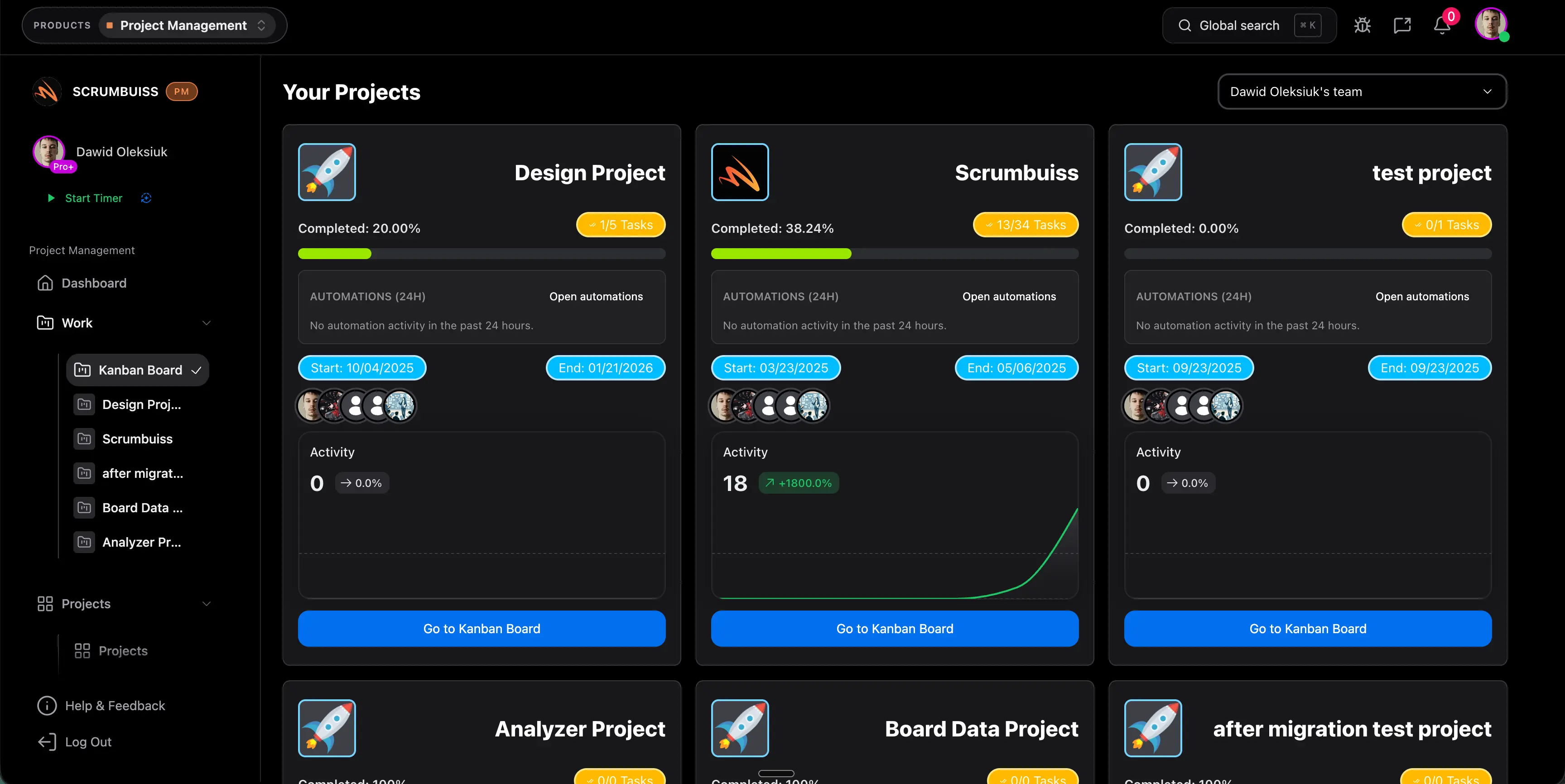
Scrumbuiss
- Best for: Software teams, agencies, and IT operations groups that want agile delivery, reporting, and adjacent workflows in one product instead of a growing stack.
- Strengths: Scrumbuiss combines sprint planning, Kanban execution, timelines, workload visibility, dashboards, time tracking, files, forms, and adjacent operational workflows inside one environment. That makes it strong for teams that want planning, execution, and reporting to stay closer together.
- Limits: It is a narrower ecosystem than Jira, Azure DevOps, or some broader enterprise platforms. Teams that need a massive marketplace, very deep ecosystem standardization, or a pure lightweight board may prefer another option.
- Pricing note: Scrumbuiss offers a 14-day full-product trial, then Team at $9 monthly / $7 annual per full member and Business at $17 monthly / $14 annual per full member, with guests and viewers free on the pricing page.
- Why it made the list: Scrumbuiss is one of the few tools on this list that is not just selling agile boards. It is selling a wider operating layer for delivery teams. If you want to see the strongest fit, start with Project Delivery and the software teams workflow page.
Best Choice By Team Type
| Team type | Best overall pick | Strong alternative | Why |
|---|---|---|---|
| Software teams | Jira | Scrumbuiss or Linear | Jira wins when Atlassian standardization matters most. Scrumbuiss is stronger when delivery planning, reporting, and adjacent workflows should stay in one layer. Linear is strongest when speed and focus matter more than breadth. |
| Agencies | Teamwork | Scrumbuiss or Asana | Teamwork is agency-native around time and client economics. Scrumbuiss is a strong alternative when agencies want delivery, files, and reporting in one product. Asana works when collaboration breadth matters more than utilization detail. |
| IT operations | Azure DevOps | Jira or Scrumbuiss | Azure DevOps is strong for Microsoft-centric engineering operations. Jira works well in Atlassian-heavy environments. Scrumbuiss is a better fit when changes, delivery visibility, and stakeholder reporting need to stay connected. |
| Small cross-functional teams | ClickUp | Asana or Trello | ClickUp gives small teams a lot of capability without immediate enterprise pricing. Asana is easier for clean collaboration. Trello is still valid when the team truly only needs a board. |
How To Choose The Right Agile Tool
Use this checklist before you run a trial:
- Pick one weekly workflow to evaluate, such as sprint planning, release review, agency handoff, or change coordination.
- Decide whether reporting for managers and stakeholders needs to live in the same tool as the delivery work.
- List the non-negotiable adjacent workflows: time tracking, budgeting, files, approvals, incident/change coordination, or code-linked delivery.
- Check how much admin work the tool needs before two teams can follow the same process consistently.
- Price the real stack, not just the cheapest seat. Include guest rules, add-ons, higher-tier reporting, and any tool you still need beside it.
- Pilot with a real backlog, real owners, real deadlines, and one live reporting meeting.
- Ask one simple question at the end of the pilot: did this reduce coordination work, or did it just move it somewhere else?
When Scrumbuiss Is A Fit / Not A Fit
When Scrumbuiss is a fit
- Your team wants agile delivery plus stakeholder-friendly reporting in one place.
- You are trying to reduce tool sprawl around sprint planning, timelines, time tracking, files, and adjacent operational workflows.
- You need a practical operating layer for software teams rather than a board plus several side systems.
- You want to compare a simpler stack directly against established tools such as Jira, Asana, monday.com, and Trello.
When Scrumbuiss is not a fit
- You already run a deeply standardized Atlassian or Microsoft stack and replacing it would cost more than it saves.
- You need the largest possible extension marketplace and very specific ecosystem dependencies.
- Your team only needs a simple board and does not care about reporting, planning depth, time, files, or adjacent workflows.
FAQ
Frequently
asked
questions
Unlock Success &
Power Up Your Projects
Next to explore
Explore more pages to understand the product suite, common workflows, and evaluation guides.