Pricing buyer guide

Reviewed on March 18, 2026

Scrumbuiss Pricing

Use this pricing page when you are deciding whether Scrumbuiss fits your team, how many people actually need paid seats, and whether the Business plan is necessary for scale, automation volume, or procurement review.

Guests and viewers stay free. The live pricing table is the canonical source for current plan details, and the buyer-guide sections underneath help you pressure-test Team, Business, annual billing, and enterprise review before you buy.

Start with a 14-day trial Paid seats are for full members. Guests and viewers are free. Compare Team vs Business before procurement turns it into a separate project.

How we reviewed Scrumbuiss pricing

This page is written as a buyer guide, not just a pricing grid. We checked the current public Scrumbuiss plans against the public pricing pages of Asana, monday.com, and Wrike, then kept the comparison narrow enough to answer the real buying questions: entry path, annual billing, collaborator policy, and enterprise review.

  • Reviewed the current public plan details and annual-billing notes on March 18, 2026.
  • Focused the comparison on the pricing questions buyers can confirm quickly from public pricing pages, instead of inventing a broad feature scorecard.
  • Kept the page aligned with Google guidance on helpful, descriptive, people-first content so one URL answers one pricing decision clearly.

Choose YourPerfect Plan

Discover flexible pricing options designed to fit any budget. Choose the plan that suits your needs and start optimizing your projects today. No hidden fees, just straightforward pricing.

Most popular

Team

For growing teams delivering sprint and board work.

Monthly$9

per user / month

  • Unlimited projects and boards

  • Up to 30 full members

  • Guests/viewers are free

  • 10GB file storage

  • Up to 3,000 AI actions/day

  • Up to 25 active automations per workspace

Start with a 14-day trial

$0.00 due today. No card required.

Business

For agencies and advanced teams that need control and scale.

Monthly$17

per user / month

  • Unlimited members

  • Advanced admin controls

  • Unlimited projects and boards

  • 100GB file storage

  • Up to 15,000 AI actions/day

  • Up to 250 active automations per workspace

Start with a 14-day trial

$0.00 due today. No card required.

Start with a 14-day trial

Try the full product with no card to start, then switch to Team or Business when you are ready.

Need enterprise-grade support?

We support security reviews, compliance requests, and custom agreements for larger organizations.

Contact us

What the plans unlock

One delivery operating layer instead of a disconnected buying stack

Pricing decisions get easier when buyers can see what the seats actually cover. Scrumbuiss pricing is attached to one operating layer for planning, delivery, reporting, files, CRM handoff, and AI-assisted work instead of pricing each workflow as a separate product decision.

  • Team covers up to 30 full members, up to 10GB, and 3000 req / day in the same workspace.
  • Business expands to unlimited full members, up to 100GB, up to 15,000 AI actions/day, and up to 250 active automations per workspace when scale or governance becomes the blocker.
  • Guests/viewers are free so you can keep external reviewers, clients, or leadership stakeholders in the workflow without turning every read-only participant into a paid seat.
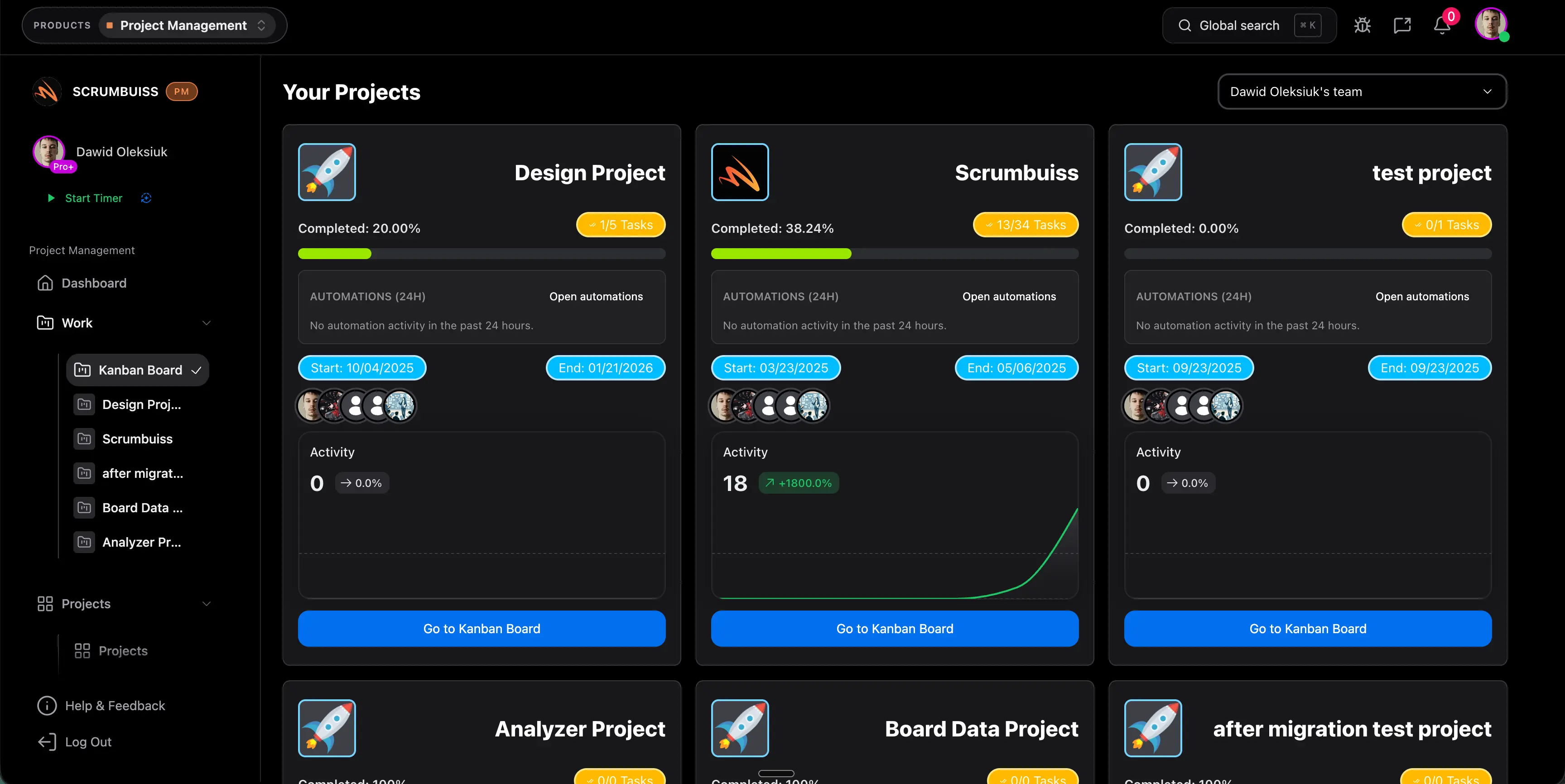
Scrumbuiss project delivery workspace overview

Pricing snapshot vs Asana, monday.com, and Wrike

This is not a universal winner table. It is a fast pricing-side read on what a buyer can confirm from the public plan pages when Scrumbuiss is being compared with broader work-management platforms.

Criteria Scrumbuiss Asana monday.com Wrike
Entry path 14-day full-product trial, then Team at $9 monthly or $7 annual per paid seat. Free Personal plan for up to 2 users, then Starter at $10.99 per user per month billed annually. Free for up to 2 seats, then Basic at EUR9 per seat per month billed annually. Free plan, then Team at $10 per user per month, displayed on an annual-billing basis.
Annual-billing signal Annual lowers Team from $9 to $7 and Business from $17 to $14. Yearly plan messaging highlights savings up to 18% on paid tiers. Yearly billing is promoted as an 18% discount versus monthly billing. Public pricing is shown per month and billed on an annual per-user basis.
Guest or viewer policy Guests and viewers are free, so you only pay for full members who actively work in the workspace. Starter and above highlight unlimited free guests for outside collaborators. Basic highlights unlimited free viewers, while guest access appears on Standard and above. The pricing-page summary emphasizes user bands and plan depth more than a simple free-viewer promise.
Enterprise and security path Business is the starting path when security review, procurement, or custom agreement questions enter the deal. Admin controls begin on Starter, scaled security appears on Advanced, and Enterprise sits on a contact-sales path. Enterprise adds governance, multi-level permissions, enterprise-scale automations, and 24/7 priority support. Pinnacle and Apex are contact-sales tiers with advanced security, compliance, reporting, and capacity controls.
Product-sprawl tradeoff Best when you want one pricing conversation across delivery, reporting, files, CRM handoff, ITSM, and AI-assisted work. Strong general work-management breadth, but the plan conversation expands quickly into portfolios, AI credits, and larger-team controls. Broad work OS positioning gives flexibility, but buyers must also account for board depth, AI bundle decisions, and wider product packaging. Deep workflow and reporting control, though add-ons and higher enterprise tiers can make packaging more layered for smaller teams.

Competitor notes reflect public pricing pages reviewed on March 18, 2026. Where a vendor pushes collaborator rules or enterprise details deeper into feature documentation, this table reflects the buyer-facing pricing page signal rather than undocumented assumptions.

Which plan fits which team

The useful pricing question is not company size alone. It is which team shape is buying, how many full members need seats in the first live rollout, and whether procurement is already shaping the decision.

Small delivery team validating fit

Start here when you want a real pilot before finance or procurement turns the pricing conversation into theory.

  • Try the full product with no card to start, then switch to Team or Business when you are ready.
  • Usually the cleanest path when you expect fewer than up to 30 full members in the first live workspace.
  • Use the first 14 days to separate full members from guests and viewers before you buy seats you do not need.

Growing software or project delivery team

This is the default Team-plan path when the buying goal is one operating layer for planning, execution, reporting, and stakeholder visibility.

  • Fit is strongest when Team already covers the first rollout with up to 10GB and up to 25 active automations per workspace.
  • Guests/viewers are free, which keeps outside collaborators readable in the workflow without forcing another seat model.
  • Best for teams that want to validate value through one real delivery workflow before they optimize for larger-org controls.

Agency or larger organization with procurement review

Move to the Business path when scale, client-facing coordination, or enterprise review becomes part of the purchase instead of an afterthought.

  • Use Business when you need unlimited full members, up to 100GB, or up to 250 active automations per workspace.
  • Business is also the right route when the buyer needs security review support, agreement questions answered, or a clearer procurement path.
  • This is the plan to test when a team is already convinced by the workflow and the real blocker is scale or governance.

Annual savings

Annual billing changes the per-paid-seat price while keeping you in the same Team or Business tier. Use these numbers when you want a cleaner budget conversation before rollout.

Team

Annual billing lowers Team from $9 to $7 per paid seat each month, which is $24 less per seat over a full year.

Per-seat savings

$24

Monthly

$9

per user / month

Annual

$7

per user / month

Business

Annual billing lowers Business from $17 to $14 per paid seat each month, which is $36 less per seat over a full year.

Per-seat savings

$36

Monthly

$17

per user / month

Annual

$14

per user / month

What changes when you move from Team to Business

Business is not a separate product line. It expands the same operating layer with more capacity and stronger support for organizations whose buying process is more demanding.

  • Full-member capacity moves from up to 30 full members to unlimited full members.
  • File storage moves from up to 10GB to up to 100GB.
  • AI action capacity moves from 3000 req / day to up to 15,000 AI actions/day.
  • Active automation capacity moves from up to 25 active automations per workspace to up to 250 active automations per workspace.
  • Security review and larger-organization buying questions get a more direct path instead of being handled as exceptions after purchase.

Billing and seat rules buyers usually ask about

These questions typically decide whether procurement gets simpler or stalls. The page should answer them directly instead of forcing the buyer into support or demo conversations too early.

  • Paid seats are for full members. Guests and viewers are free, so you only pay for teammates who actively work in the workspace.
  • Membership licenses are purchased by seats, which can be provisioned to or removed from users.
  • Stripe allows you to pay and manage your subscription with multiple payment options. Get detailed invoices for your subscription.
  • Annual billing changes the per-seat price, not the product you are buying. Monthly is the faster pilot path; annual is the cleaner cost-control path once the workflow is already proven.

Enterprise and security review path

Larger organizations often need to validate security, agreement, or procurement details before they standardize. This page should make that path visible without pretending every buyer needs an enterprise sales cycle.

We support security reviews, compliance requests, and custom agreements for larger organizations.

Business includes custom security assessment support in the published pricing matrix.

Business includes custom agreement support in the published pricing matrix.

14-day pricing validation checklist

The fastest way to buy the right plan is to test pricing through one real workflow instead of through abstract seat estimates.

  1. Step 1

    Start the trial with one live workflow that includes the people who will actually plan, update, review, and approve work each week.

  2. Step 2

    Mark who truly needs full-member access versus who can stay guest or viewer only.

  3. Step 3

    Use the trial to test automations, files, AI actions, and reporting in the same workspace so plan choice reflects real usage, not a feature wishlist.

  4. Step 4

    Check whether Team limits are actual blockers or whether the workflow is already proven without Business-level capacity.

  5. Step 5

    If finance needs a cleaner budget case, compare monthly versus annual pricing only after the first live workflow is already working.

  6. Step 6

    If procurement or security review enters the deal, move the conversation to the Business path early instead of treating those questions as last-minute exceptions.

Pricing FAQ

These are the practical buying questions teams usually need answered before they request approval, start procurement, or commit to annual billing.

Do you offer a free trial before subscribing?

Yes. Scrumbuiss offers a 14-day full-product trial with no card required so teams can validate workflow fit before they choose Team or Business.

Who needs a paid seat in Scrumbuiss?

Paid seats are for full members who actively collaborate in the workspace. Guests and viewers are free, so they do not need paid seats just to review or stay informed.

Are guests and viewers really free?

Yes. The pricing model is designed so outside collaborators, clients, or leadership viewers can stay connected to the workflow without automatically becoming paid full members.

When should I choose Team instead of Business?

Team is the default fit when your first rollout already works with up to 30 full members, up to 10GB, 3000 req / day, and up to 25 active automations per workspace. Choose Business when you need more capacity, stronger governance support, or a clearer enterprise review path.

What changes if I choose annual pricing instead of monthly?

Team moves from $9 to $7 per paid seat per month when billed annually, and Business moves from $17 to $14. Annual billing lowers the per-seat cost, but it does not change the product or the workflow you are buying.

Can I start on Team and upgrade later?

Yes. Teams can start on the lower-friction path, prove the workflow, and then move to Business later if seat count, storage, automation volume, or procurement requirements become the real constraint.

How should I test pricing during the trial?

Use one real workflow, count full members versus guests or viewers, and test the automations, files, reporting, and AI actions that matter in daily use. That gives you a cleaner pricing decision than estimating from a feature checklist alone.

What if my company needs security review or procurement documentation?

Use the Business path as the starting point. That is where larger organizations should begin when security review, compliance questions, or custom agreement needs are part of the purchase process.

Unlock Agile Success
Get started or contact us today!

Related workflow

Need to pressure-test pricing against the real agency workflow?

Use the client project management software guide when the buying decision depends on more than seats and plan limits, including intake, briefs, files, approvals, tracked effort, workload, and client-visible status in one delivery model.

Read the client project management guide