Stakeholder Register Guide
A stakeholder register is the structured list of people, teams, clients, vendors, and groups involved in or affected by a project. It gives the project manager one place to keep stakeholder roles, influence, interests, communication needs, and ownership visible.
This guide targets the stakeholder register keyword cluster found during SEMrush research. It is narrower than the stakeholder management guide because it focuses on the register artifact itself.
Key Takeaways
- A stakeholder register is the source list for stakeholder analysis and communication planning.
- It should include decision rights, not only names and job titles.
- The register should be maintained as stakeholders join, leave, or change responsibility.
- Sensitive stakeholder notes should be handled carefully and kept relevant to project delivery.
What Is a Stakeholder Register?
A stakeholder register is a project document that records stakeholder information needed to plan engagement and communication. It helps answer:
- Who is involved in the project?
- Who is affected by the outcome?
- Who gives input, approval, funding, or acceptance?
- Who owns the relationship?
- What information does each stakeholder need?
- What concerns or risks should the team monitor?
It usually starts during initiation and becomes more useful after stakeholder analysis and kickoff.
Stakeholder Register Fields
| Field | Purpose |
|---|---|
| Name or group | Identifies the stakeholder |
| Organization or team | Shows where they sit |
| Role in project | Explains involvement or impact |
| Influence | Indicates decision or escalation power |
| Interest | Shows expected attention level |
| Decision rights | Clarifies approval, advisory, or informed status |
| Communication need | Defines what they need to know |
| Owner | Names who manages the relationship |
| Notes | Captures constraints, concerns, or follow-up context |
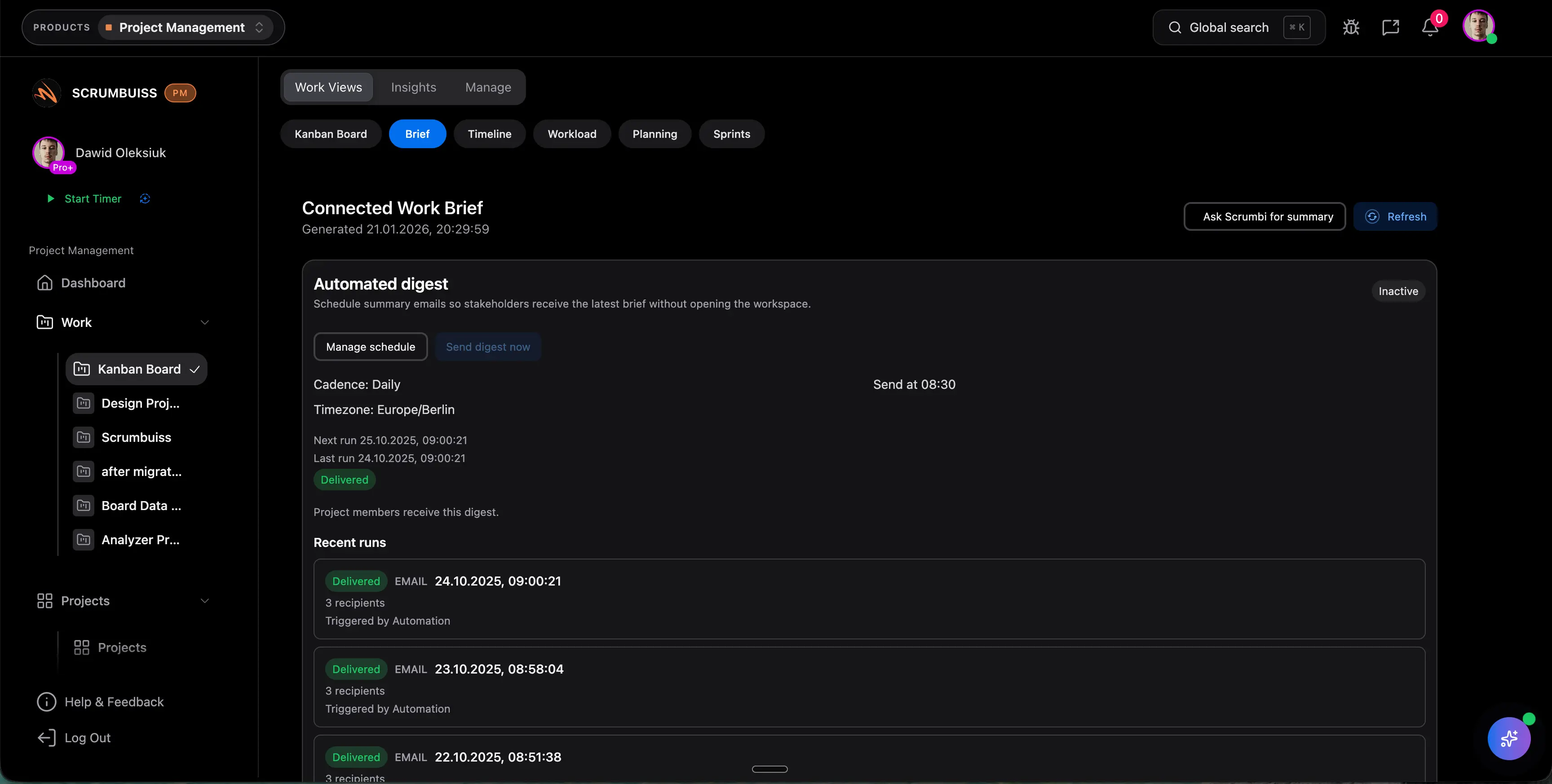
Scrumbuiss can keep stakeholder context attached to delivery through Project Brief, Client Portal, Files, Dashboard, and Activity Feed.
Stakeholder Register Example
| Stakeholder | Role | Influence | Communication need | Owner |
|---|---|---|---|---|
| Executive sponsor | Approves budget and priorities | High | Health, budget, risks, decisions | Project manager |
| Client operations lead | Confirms rollout needs | Medium | Timeline, handoff, training | Account lead |
| Delivery lead | Owns build execution | Medium | Tasks, blockers, dependencies | Project manager |
| Support manager | Supports post-launch users | Low | Documentation and go-live readiness | Operations lead |
The register should stay factual. Use it to plan engagement, not to store irrelevant personal opinions.
Best Practices
Separate contact details from project context
If contact information is stored elsewhere, the register can focus on project role, decision rights, communication needs, and engagement risk.
Keep decision authority visible
Projects slow down when everyone knows who is interested but no one knows who approves.
Link the register to the communication plan
The register identifies who matters. The project communication plan defines how and when to engage them.
FAQ
Frequently
asked
questions
Related features
Explore the Scrumbuiss features mentioned in this article.
- Project Brief
Create a shareable project brief that stays connected to scope, files, and stakeholder updates.
- Client Portal
Invite clients into a controlled onboarding, file-sharing, and status workflow.
- Dashboard
Track project progress, blockers, workload, KPIs, status reporting, and analytics context in one live dashboard.
- Activity Feed
Stay up to date with real-time updates on tasks, progress, and team activities.
Unlock Success &
Power Up Your Projects
Next to explore
Explore more pages to understand the product suite, common workflows, and evaluation guides.