Story Points Guide
Story points are a relative estimation method used by many agile teams. They help teams compare effort, complexity, uncertainty, and risk without pretending every item can be estimated precisely in hours.
This guide targets the story points keyword cluster found in SEMrush. It connects to sprint planning, planning poker, and burndown chart content.
Key Takeaways
- Story points estimate relative size, not exact hours.
- Good story point discussions reveal complexity, uncertainty, and hidden assumptions.
- Fibonacci-style numbers are common because they discourage false precision.
- Story points should not be used to compare individual performance.
What Are Story Points?
Story points are units used to estimate the relative size of backlog items. A team might size items as 1, 2, 3, 5, 8, or 13 points.
Points usually reflect:
- effort
- complexity
- uncertainty
- risk
- amount of unknown work
The value comes from the team discussion, not just the number.
Story Points vs. Hours
| Area | Story points | Hours |
|---|---|---|
| Estimate type | Relative size | Time estimate |
| Best for | Comparing backlog items | Scheduling known work |
| Strength | Handles uncertainty better | Easier for external planning |
| Risk | Can be misused as productivity metric | Can imply false precision |
Teams may still need dates, but story points help the team discuss effort before making commitments.
Story Point Example
| Backlog item | Example estimate | Why |
|---|---|---|
| Update button copy | 1 | Very small, low uncertainty |
| Add dashboard filter | 3 | Known pattern, some testing |
| Build new approval workflow | 8 | Multiple states, edge cases, stakeholder review |
| Integrate external data source | 13 | High dependency and uncertainty |
Each team's scale is local. One team's 5-point story is not necessarily another team's 5-point story.
How To Estimate Story Points
- Clarify the user story and acceptance criteria.
- Discuss assumptions and unknowns.
- Compare the item with past work.
- Estimate independently.
- Discuss large differences.
- Agree on a relative size.
- Revisit if new information changes the work.
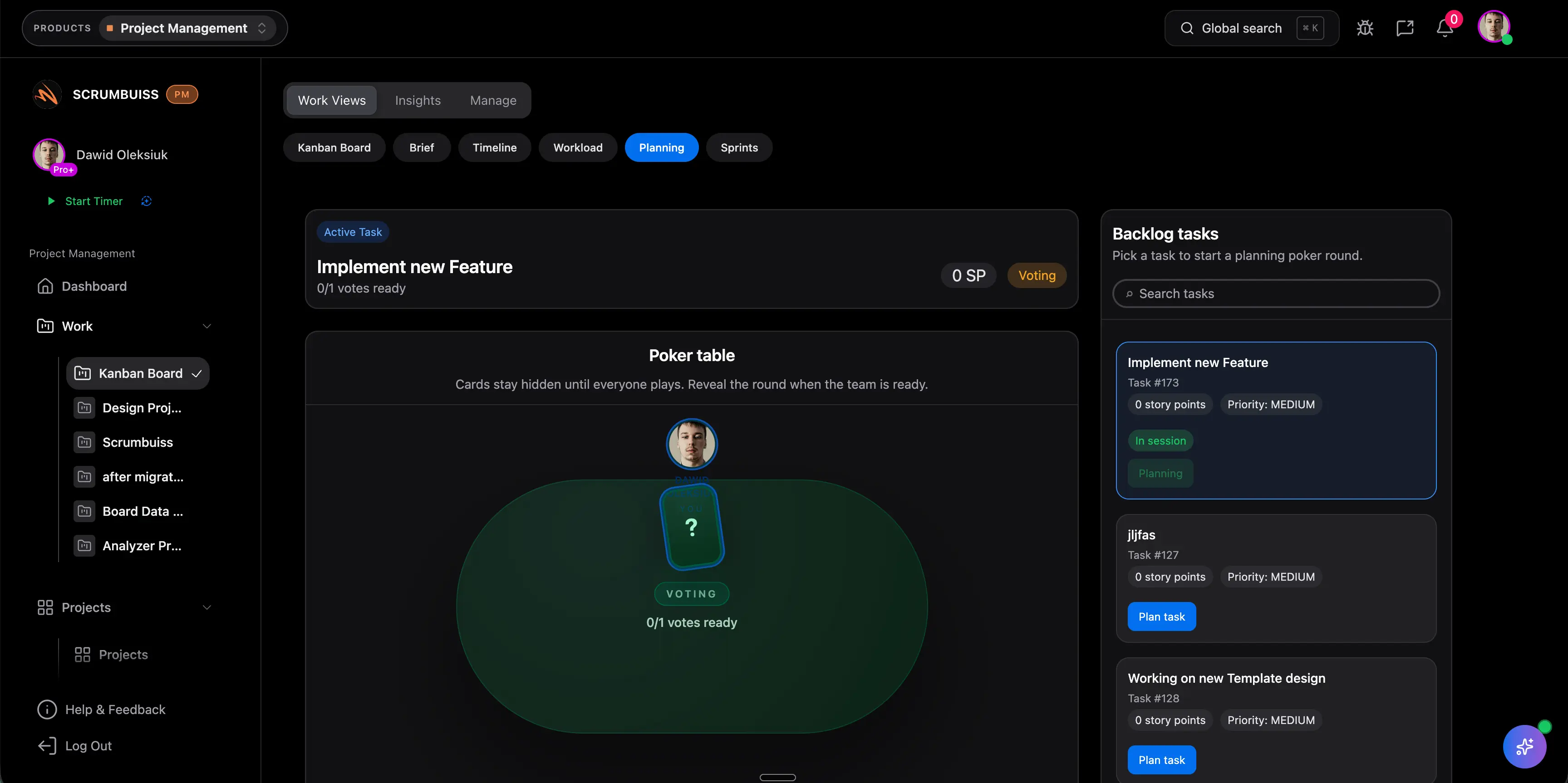
Use planning poker when the team needs a structured estimation conversation.
FAQ
Frequently
asked
questions
Unlock Success &
Power Up Your Projects
Next to explore
Explore more pages to understand the product suite, common workflows, and evaluation guides.