Risk Management Plan Guide
A risk management plan defines how a project will identify, assess, respond to, monitor, and report risk. It is the operating agreement for risk work, while the risk register is the live list of individual risks.
This guide targets the risk management plan keyword cluster found in SEMrush. It expands on the plan section in the project risk management guide and keeps the focus on the plan artifact itself.
Key Takeaways
- A risk management plan explains how risk work will be done before the project is under pressure.
- The plan should define scoring, ownership, response strategies, review rhythm, and escalation rules.
- It should be practical enough for weekly use, not a policy document that nobody reads.
- The plan should connect to the risk register, project status report, and governance meetings.
What Is a Risk Management Plan?
A risk management plan is a project document that sets the rules for managing uncertainty. It does not list every risk in detail. Instead, it defines the process the team will use to manage risks consistently.
| Plan area | Purpose |
|---|---|
| Risk categories | Helps the team find risks across scope, schedule, budget, technical, vendor, stakeholder, and quality areas |
| Scoring method | Defines probability, impact, and priority rules |
| Roles | Shows who owns the process and who owns individual risks |
| Responses | Defines how risks can be avoided, reduced, transferred, accepted, escalated, or monitored |
| Cadence | Sets review timing for planning, delivery, milestones, and governance |
| Reporting | Explains which risks appear in dashboards and status reports |
| Escalation | Defines when sponsor or steering decisions are needed |
Risk Management Plan vs. Risk Register
| Item | Risk management plan | Risk register |
|---|---|---|
| Purpose | Defines how risk will be managed | Tracks actual project risks |
| Timing | Created during planning and updated when process changes | Updated throughout delivery |
| Content | Rules, roles, scoring, cadence, escalation | Risk statements, scores, owners, actions, status |
| Owner | Project manager or PMO | Project manager with risk owners |
Use the risk register guide when you need the live tracking format.
What To Include
| Section | Questions to answer |
|---|---|
| Risk approach | How will risks be identified and reviewed? |
| Risk categories | What types of project uncertainty matter most? |
| Probability scale | How will likelihood be scored? |
| Impact scale | How will schedule, cost, scope, quality, and adoption impact be scored? |
| Priority bands | What makes a risk low, medium, high, or critical? |
| Roles | Who facilitates risk review and who owns mitigation? |
| Review cadence | Which meetings include risk review? |
| Reporting rules | Which risks go into status reports or dashboards? |
| Escalation rules | What triggers sponsor, steering, or change control decisions? |
When To Create It
Create the plan before major delivery work starts. Update it when the project becomes more complex, a new vendor joins, governance changes, or risk appetite shifts.
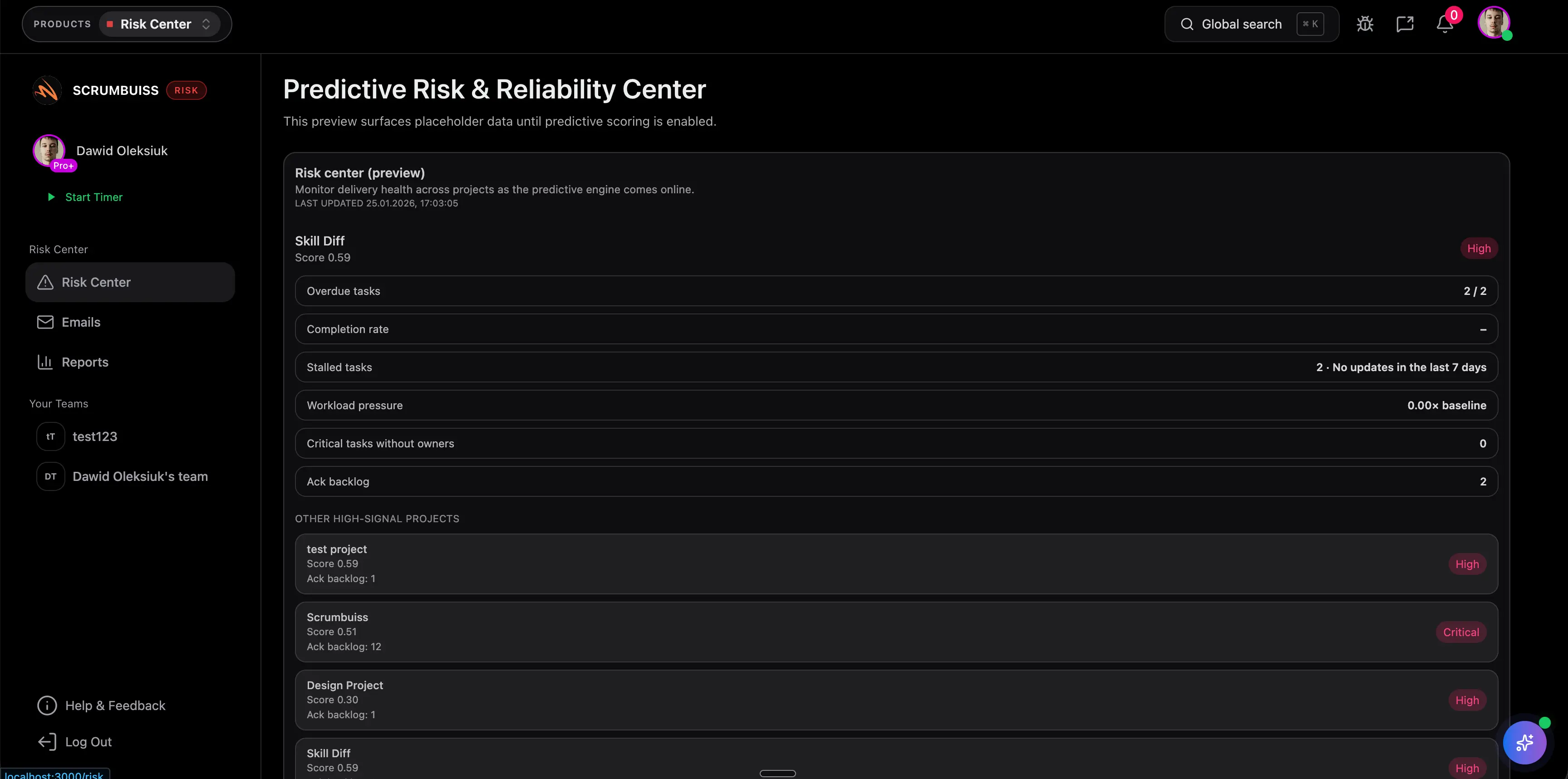
Scrumbuiss helps operationalize the plan through Risk Center, Project Delivery, Dashboard, and Portfolio.
FAQ
Frequently
asked
questions
Related features
Explore the Scrumbuiss features mentioned in this article.
- Dashboard
Track project progress, blockers, workload, KPIs, status reporting, and analytics context in one live dashboard.
Unlock Success &
Power Up Your Projects
Next to explore
Explore more pages to understand the product suite, common workflows, and evaluation guides.