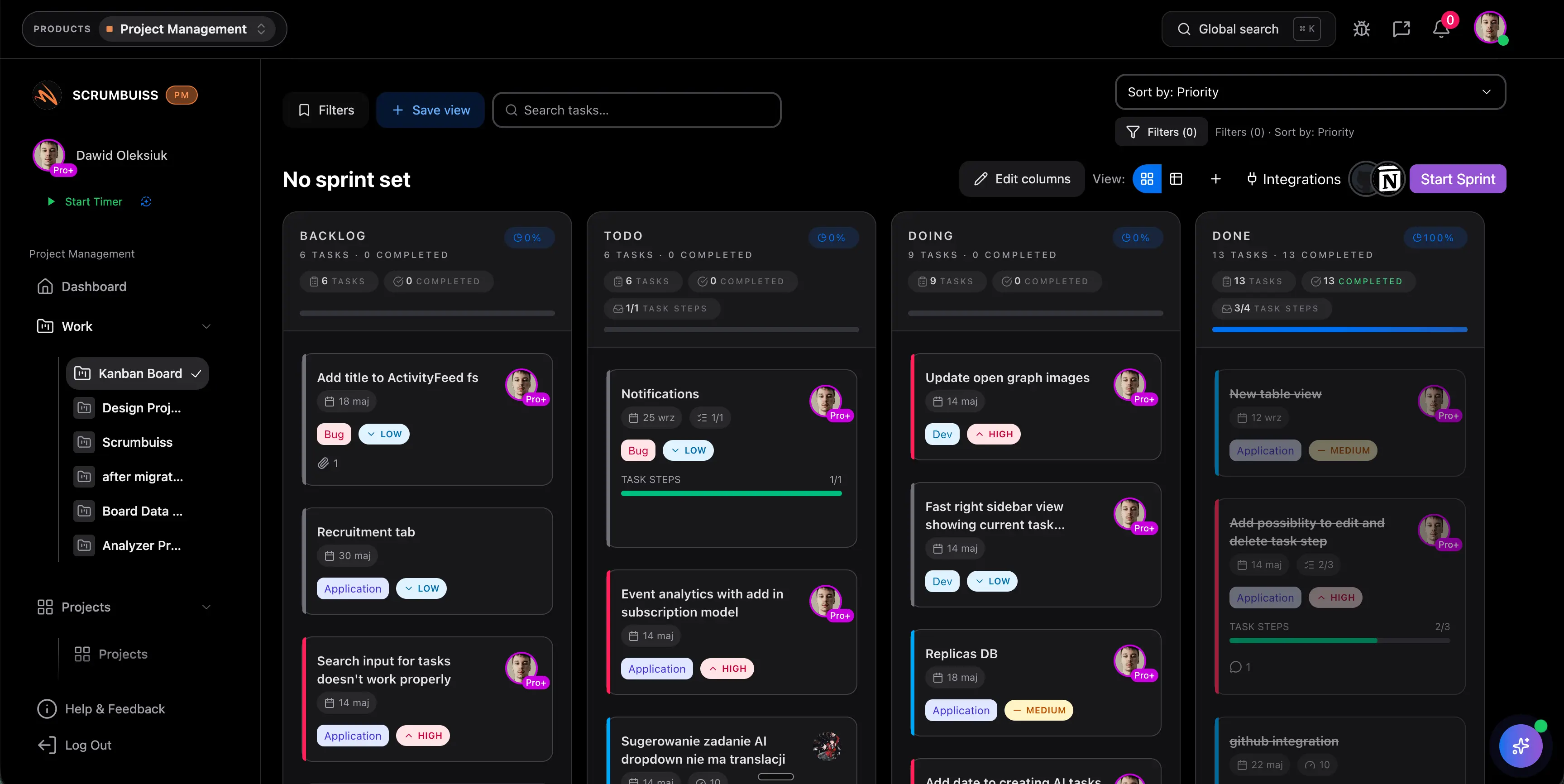
Software Project Management Guide for Delivery Teams
Software project management is the operating system that turns product ideas, engineering work, bugs, releases, and stakeholder requests into delivered software. It is not only sprint ceremonies or a ticket board. Good software project management connects scope, technical risk, dependencies, team capacity, release confidence, and reporting in one repeatable workflow.
This guide was created for teams searching for "software project management" and "management in software project" who need a practical explanation rather than a generic tool list. Keyword research was reviewed in the SEMrush US database on July 2, 2026, and the page is written to support software teams without competing with the broader project management tools buyer guide or the engineering project management software guide.
Key Takeaways
- Software project management coordinates discovery, planning, build, review, release, and learning across product, engineering, QA, design, operations, and stakeholders.
- The strongest teams separate the product decision, the technical plan, the delivery workflow, and the status report instead of forcing one board to answer every question.
- Software work needs explicit handling for dependencies, estimation uncertainty, defect work, release risk, and changing requirements.
- A useful software project management system should connect backlog, sprints, timelines, workload, risks, files, and dashboards so leaders do not rebuild status manually.
What Is Software Project Management?
Software project management is the discipline of planning, coordinating, tracking, and improving software delivery work from idea to release. It includes the project management basics every team needs, such as scope, schedule, ownership, risk, communication, and stakeholder alignment. It also adds the realities of software work: discovery, technical uncertainty, backlog refinement, sprint planning, code review, testing, deployment, and post-release learning.
In a healthy setup, the project manager, product owner, tech lead, engineering manager, designer, QA owner, and stakeholders can all answer the same questions:
| Question | Why it matters in software projects |
|---|---|
| What are we building? | Scope drift starts when requirements, acceptance criteria, and user outcomes are unclear. |
| Why now? | Product and engineering teams need priority context before they commit capacity. |
| Who owns each decision? | Delivery slows when product, technical, QA, and business decisions have no clear owner. |
| What could block us? | Dependencies, review queues, environment constraints, and integration work can delay the release. |
| How will we report progress? | Stakeholders need a readable view without asking engineers to translate ticket detail every week. |
Software Project Management vs. General Project Management
General project management gives the structure: define goals, plan work, manage risk, communicate progress, and close the loop. Software project management applies that structure to a delivery environment where requirements evolve and the work is often discovered as the team builds.
That difference changes the workflow:
| Area | General project management | Software project management |
|---|---|---|
| Scope | Often defined before execution | Refined through discovery, backlog shaping, and feedback |
| Schedule | Milestones and dependencies | Sprints, releases, dependencies, code freeze, QA, deployment |
| Risk | Budget, scope, resource, vendor, timeline | Technical debt, architecture, integration, defects, environments |
| Reporting | Status, budget, timeline, risks | Sprint progress, release confidence, blockers, quality signals |
| Change control | Formal change requests | Backlog reprioritization, tradeoffs, release-scope negotiation |
If your main question is the project management lifecycle itself, read the project management process guide. If your team already knows the process but needs a repeatable operating model, use the project management workflow guide.
The Software Project Management Lifecycle
Most software teams can use six lifecycle stages. The labels can change, but the control points should remain visible.
| Stage | Main output | Common failure mode |
|---|---|---|
| Intake and discovery | Problem statement, business case, assumptions, early scope | Work starts from a vague request instead of an evaluated need |
| Planning | Milestones, backlog, owners, acceptance criteria, dependencies | The plan lists tasks but misses technical or cross-team dependencies |
| Build and coordination | Sprint commitments, active work, blockers, review flow | Status lives in tickets while decision context lives elsewhere |
| Validation | QA plan, test evidence, stakeholder review, release readiness | Defects and feedback arrive late because review was not planned |
| Release | Deployment plan, rollback path, communication, adoption notes | The release is treated as a ticket closure instead of a business handoff |
| Retrospective | Lessons, estimate updates, process changes, follow-up work | The team ships and moves on without improving the next cycle |
Scrumbuiss supports this kind of lifecycle when teams connect Project Delivery, Sprints, Project Brief, Gantt Timeline, Workload & Capacity, Risk Center, and Dashboard instead of spreading the lifecycle across disconnected tools.
Roles in Software Project Management
Software projects fail when every role is busy but no one owns the handoff between decisions. Use clear role boundaries:
| Role | Owns | Should not own alone |
|---|---|---|
| Product owner or product manager | User need, business priority, acceptance criteria, release tradeoffs | Technical design or engineering estimates |
| Project manager or delivery lead | Delivery plan, timeline, risk review, stakeholder communication | Product strategy or code quality |
| Tech lead | Architecture, technical approach, dependency mapping, quality bar | Business prioritization |
| Engineering team | Implementation, estimates, testing evidence, technical feedback | Final scope decisions without product context |
| QA or validation owner | Test approach, regression risk, release confidence | Fix prioritization without product and technical input |
| Stakeholders | Business constraints, approvals, adoption expectations | Day-to-day sprint management |
Small teams may combine roles, but the decisions still need owners. A founder can be product owner and stakeholder. A senior engineer can act as tech lead and delivery lead. The risk is not combined roles; the risk is invisible decisions.
A Practical Software Project Management Workflow
Use this workflow when a request moves from idea to release:
- Capture the request with enough context to evaluate it.
- Convert the request into a brief with goal, users, constraints, risks, and success criteria.
- Break the work into backlog items with clear acceptance criteria.
- Map dependencies before the sprint or release plan is locked.
- Estimate with uncertainty ranges, not false precision.
- Commit capacity based on actual team load.
- Track progress, blockers, and review state in the same delivery workspace.
- Review quality and release readiness before stakeholder sign-off.
- Report status with milestones, risk, workload, and next decisions.
- Capture lessons and update the next planning cycle.
This is where the software management layer matters. A board can show work status, but it often misses brief context, workload limits, dependency timing, and stakeholder-ready reporting. Teams that feel that gap usually need a tighter workflow before they need more ceremonies.
Metrics That Matter
Software project management metrics should improve decisions, not create a scoreboard for teams to game. Start with a small set:
| Metric | Use it to answer |
|---|---|
| Planned vs. completed work | Did the sprint or release commitment match reality? |
| Blocked work age | Where is work waiting too long for a decision, review, or dependency? |
| Cycle time | How long does work take once it enters execution? |
| Defect escape rate | Are quality issues being caught before release? |
| Rework share | How much capacity is spent correcting unclear requirements or poor handoffs? |
| Workload pressure | Are the same people becoming the recurring bottleneck? |
| Release readiness | Are scope, quality, support, and communication ready together? |
If reporting is the weak point, use a weekly project status report to translate delivery signals into a stakeholder-readable format.
How To Choose Software Project Management Tools
Do not start with a vendor comparison. Start with the operating problem.
| If your problem is... | Prioritize |
|---|---|
| Backlog work is unclear | Briefs, acceptance criteria, and product context |
| Sprint commitments are unrealistic | Workload, capacity, and dependency review |
| Stakeholders keep asking for status | Dashboards and weekly reporting |
| Releases miss hidden blockers | Risks, milestones, and release-readiness checks |
| Engineering and non-engineering teams cannot stay aligned | Shared project context, permissions, and readable views |
For vendor-level buying criteria, read the engineering project management software guide. For broader category selection, use the project management tools buyer guide.
FAQ
Frequently
asked
questions
Related features
Explore the Scrumbuiss features mentioned in this article.
- Sprints
Manage your sprints and tasks with our intuitive sprint view. Stay organized and on track with deadlines, milestones, and team schedules in one place.
- Project Brief
Create a shareable project brief that stays connected to scope, files, and stakeholder updates.
- Gantt Timeline
Plan dependencies, milestones, and schedule changes with a Gantt chart view that stays close to execution.
- Workload & Capacity
Balance workload, plan capacity, and spot overload early.
Unlock Success &
Power Up Your Projects
Next to explore
Explore more pages to understand the product suite, common workflows, and evaluation guides.