Project Documentation Guide
Project documentation is the set of records that explains why a project exists, what it will deliver, how it will be managed, and what decisions were made along the way. Good documentation reduces repeated questions. Weak documentation adds admin without improving delivery.
This guide targets the project documentation keyword cluster found in SEMrush. It acts as a map to related Scrumbuiss guides on charters, scope, requirements, communication, risks, and closeout.
Key Takeaways
- Project documentation should help teams make decisions, onboard contributors, and preserve project context.
- Not every project needs every document.
- Documentation is useful only when it has an owner, review cadence, and clear source of truth.
- The most important documents usually define scope, requirements, risks, decisions, status, and acceptance.
What Is Project Documentation?
Project documentation includes the written, visual, and structured records used to plan, deliver, control, and close a project.
It may include:
- project brief
- project charter
- scope statement
- requirements document
- communication plan
- risk register
- issue log
- decision log
- project schedule
- status reports
- change requests
- acceptance criteria
- closure checklist
- lessons learned
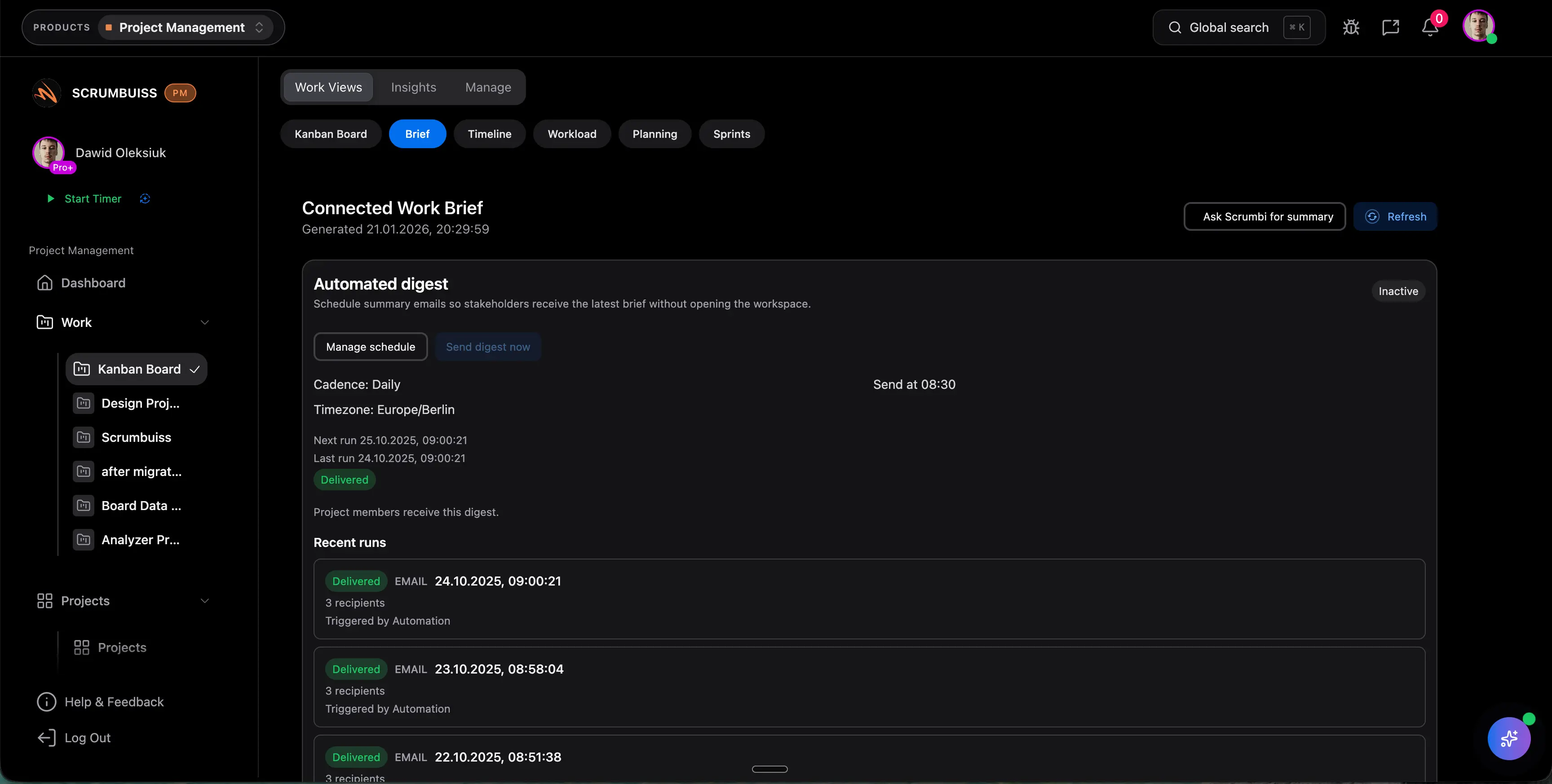
Scrumbuiss supports documentation workflows through Project Brief, Files, Forms, Project Delivery, and Dashboard.
Essential Project Management Documents
| Document | When to use it | Related guide |
|---|---|---|
| Project brief | Early alignment and intake | Project brief template |
| Project charter | Formal authorization and business context | Project charter guide |
| Scope statement | Boundaries, deliverables, exclusions, and acceptance | Scope statement guide |
| Requirements document | Functional needs, constraints, and acceptance criteria | Requirements document guide |
| Communication plan | Stakeholders, channels, cadence, and escalation | Communication plan guide |
| Risk register | Risk ownership, scoring, mitigation, and escalation | Risk register guide |
| Issue and decision log | Active problems and decision history | Issue and decision log guide |
| Status report | Progress, health, risks, and next steps | Status report guide |
| Closure checklist | Acceptance, handoff, files, and lessons learned | Closure checklist guide |
Project Documentation by Phase
| Phase | Useful documentation |
|---|---|
| Intake | Request form, project brief, business case, initial assumptions |
| Initiation | Charter, stakeholder list, high-level scope, approval record |
| Planning | Scope statement, requirements, schedule, risk register, communication plan |
| Execution | Task records, decisions, files, status reports, change requests |
| Monitoring | Dashboard, metrics, risk updates, issue log, budget or effort reports |
| Closeout | Acceptance record, handoff notes, closure checklist, lessons learned |
The goal is not to produce a folder full of documents. The goal is to keep the right context available when the team needs it.
Project Documentation Best Practices
Define one source of truth
Decide where each document lives. If the latest scope is split between a doc, chat thread, and slide deck, no one will know what was approved.
Assign document owners
Every important document needs an owner. Ownership prevents stale records and unclear updates.
Link documentation to live work
Project records should connect to tasks, files, risks, decisions, and reports. That keeps documentation close to delivery instead of locked in a static folder.
Keep documents short enough to use
Long documents are not automatically better. Include what helps readers understand decisions, constraints, and next action.
Review documentation at major checkpoints
Review scope, requirements, risks, decisions, and acceptance criteria when the project enters a new phase or materially changes.
FAQ
Frequently
asked
questions
Related features
Explore the Scrumbuiss features mentioned in this article.
- Project Brief
Create a shareable project brief that stays connected to scope, files, and stakeholder updates.
- Forms
Capture project requests with intake forms and route approved work into the right workflow.
- Dashboard
Track project progress, blockers, workload, KPIs, status reporting, and analytics context in one live dashboard.
Unlock Success &
Power Up Your Projects
Next to explore
Explore more pages to understand the product suite, common workflows, and evaluation guides.