Client Onboarding Software for Agencies and Implementation Teams
Client onboarding software should carry one client from closed-won to kickoff and the first status update without forcing the next owner to rebuild the same context in CRM notes, email threads, docs, and side trackers. Scrumbuiss is strongest when the handoff should stay connected to intake, project brief continuity, files, approvals, tracked work, and early delivery follow-through in one operating path.
Reviewed on March 23, 2026
Reviewed by Scrumbuiss editorial team
A practical workflow guide, illustrated with real Scrumbuiss screenshots.
How we evaluated client onboarding software
Reviewed on March 23, 2026 by the Scrumbuiss editorial team. This buyer guide evaluates one exact job: moving from a closed-won deal to kickoff and the first status cycle without recreating the same customer story across CRM notes, intake docs, file folders, and handoff meetings.
- We checked the page against Google Search Central guidance for helpful, reliable, people-first content and the reviews system, with emphasis on original analysis, page-level usefulness, clear sourcing, and trust signals.
- We reviewed how Scrumbuiss supports the handoff across CRM, Project Intake, Forms, Project Brief, Files, Automations, Time Tracking, Client Portal, and the client project management workflow.
- We compared that against the public positioning published by Teamwork for agencies, Clustdoc for customer onboarding software, Kissflow for workflow automation, and Clinked for portal-first client collaboration.
- We limited Scrumbuiss claims to workflows and capabilities already documented publicly in this site, and used the live-pilot test as the bar for anything buyers still need to validate.
At a glance
This page is for the handoff between a closed-won deal and the first clean delivery cycle. It is not the portal-first page and it is not the broader post-kickoff client-delivery page.
What Scrumbuiss is here
Client onboarding software for agencies and implementation teams that keeps sales handoff, kickoff brief, files, approvals, and the first owned delivery steps readable in one workflow.
Who it fits now
Teams whose deals close cleanly enough in CRM, but whose kickoff still starts with recap meetings, copied briefs, missing files, and unclear ownership.
When to choose another page
Use Client Portal when secure external access is the main buying reason. Use Client Project Management when onboarding is already stable and the real decision is how ongoing files, time, workload, approvals, and client-visible status run after kickoff.
What is shipped today
Strong fit now / Validate if you need
Strong fit now
- Closed-won work still turns into recap meetings before kickoff can start
- The next owner needs one brief, one file set, and one approval trail instead of a CRM record plus side docs
- Agencies or implementation teams want the first status cycle to stay attached to the same onboarding record
- You want to validate the handoff with one live account before standardizing a broader delivery model
Validate if you need
- A dedicated secure client portal or branded external workspace as the primary buying requirement
- A broader agency delivery or PSA suite with deeper profitability and account-operations coverage
- A workflow-automation platform first, where no-code process design matters more than delivery-connected execution
Capability matrix
This matrix keeps the claim boundaries explicit so the page answers the handoff question clearly without pretending to be a portal-first suite or a full agency-operations platform.
| Capability | Status | Notes |
|---|---|---|
| CRM handoff into onboarding | Shipped now | The site already documents connected CRM, follow-up, and sales-to-delivery handoff workflows. |
| Structured intake forms | Shipped now | Forms and intake workflows are already part of the public workflow model. |
| Project brief continuity | Shipped now | The kickoff brief can stay attached to the same operating path instead of being rebuilt from scratch. |
| Files and approval context | Shipped now | Files and approval steps are already marketed as part of the connected workflow across onboarding and delivery pages. |
| Automations and reminders | Shipped now | Automations can support routing, reminders, and follow-up while the handoff is still live. |
| Time tracking after kickoff | Shipped now | Tracked effort is already available once onboarding turns into owned delivery work. |
| Client-visible onboarding context | Partial today | Shareable brief and status outputs exist, but teams that need a deeper external-facing experience should validate the portal model directly. |
| Dedicated secure client portal | Partial today | Scrumbuiss now ships an invite-only client portal MVP, but that is a separate evaluation path from this handoff-first guide. |
| Deep profitability and PSA coverage | Planned next | Teams with a broader agency-ops or profitability requirement should validate that layer separately before replacing a larger stack. |
Who it’s for
Teams that want a clear workflow, less manual coordination, and better visibility.
- Agencies onboarding new retainers, implementations, or scoped client work after a closed-won deal
- Implementation and onboarding teams that need cleaner sales-to-kickoff continuity before delivery begins
- Operations, account, and delivery leads who want fewer recap meetings and less duplicate briefing work
- Teams choosing between a portal-first onboarding tool, an automation-first process builder, and a delivery-connected handoff workflow
Client onboarding software comparison
Client onboarding buyers usually discover the workflow gap after the deal is already marked closed-won: sales context exists somewhere, but the kickoff brief, file collection, approvals, next owner, and first client-ready update still have to be rebuilt before execution starts.
| Platform | Best fit | Main tradeoff | Where Scrumbuiss is stronger |
|---|---|---|---|
| Scrumbuiss | Agencies and implementation teams that want the handoff from CRM into kickoff brief, files, approvals, and the first delivery cycle to stay in one operating workflow. | It is a narrower handoff-first choice than the largest agency suites, workflow-automation platforms, or portal-first onboarding tools, so teams should validate it with one real closed-won handoff and one live kickoff cycle before standardizing. | Scrumbuiss wins when onboarding should stay attached to briefs, files, approvals, time, and early delivery follow-through instead of splitting the handoff across CRM, portal, PM board, and side docs. |
| Teamwork | Agencies that primarily need a broader client-delivery suite with approvals, reporting, time tracking, and account operations once delivery is already running. | It is strong when the main problem is agency delivery control, but buyers should still validate how much deal context and kickoff structure they need before the work becomes a normal delivery project. | Scrumbuiss is stronger when the real pain starts earlier, in the sales-to-kickoff handoff, not only in the delivery workflow after kickoff is already clean. |
| Clustdoc | Teams that prioritize a portal-first onboarding experience with customer-facing workspaces, document collection, reminders, and guided submission steps. | It can be the better fit when secure external participation is the main requirement, but teams should validate whether the delivery workflow after kickoff stays connected enough to avoid a second operating layer. | Scrumbuiss is stronger when the same onboarding record should keep feeding the brief, files, approvals, tracked work, and follow-up after the first collection step is complete. |
| Kissflow | Teams that want a workflow-automation-first platform to design approvals, routing rules, and onboarding logic around forms and process steps. | The process flexibility is broad, but teams should validate how much delivery context, files, reporting, and post-kickoff coordination still need separate design work after the onboarding flow is built. | Scrumbuiss is stronger when onboarding, brief continuity, files, tracked work, and the first delivery reporting cycle should be evaluated together instead of assembled as separate workflow layers. |
This is a fit-and-tradeoff view based on public positioning and visible workflow coverage, not a feature-parity procurement sheet.
Common challenges
- Closed-won work still starts with another recap meeting because the next team cannot trust the original deal context
- Scope, stakeholders, files, and promised next steps are re-entered into briefs, docs, or project boards after the sale
- Files and approvals are collected, but nobody can see one readable handoff from CRM into kickoff ownership
- The first client-ready status update still has to be rewritten from chats, docs, and separate trackers
- Portal-first or automation-first tools can solve one part of onboarding while leaving the ongoing delivery handoff disconnected
How it works
A practical workflow structure you can replicate in your own workspace.
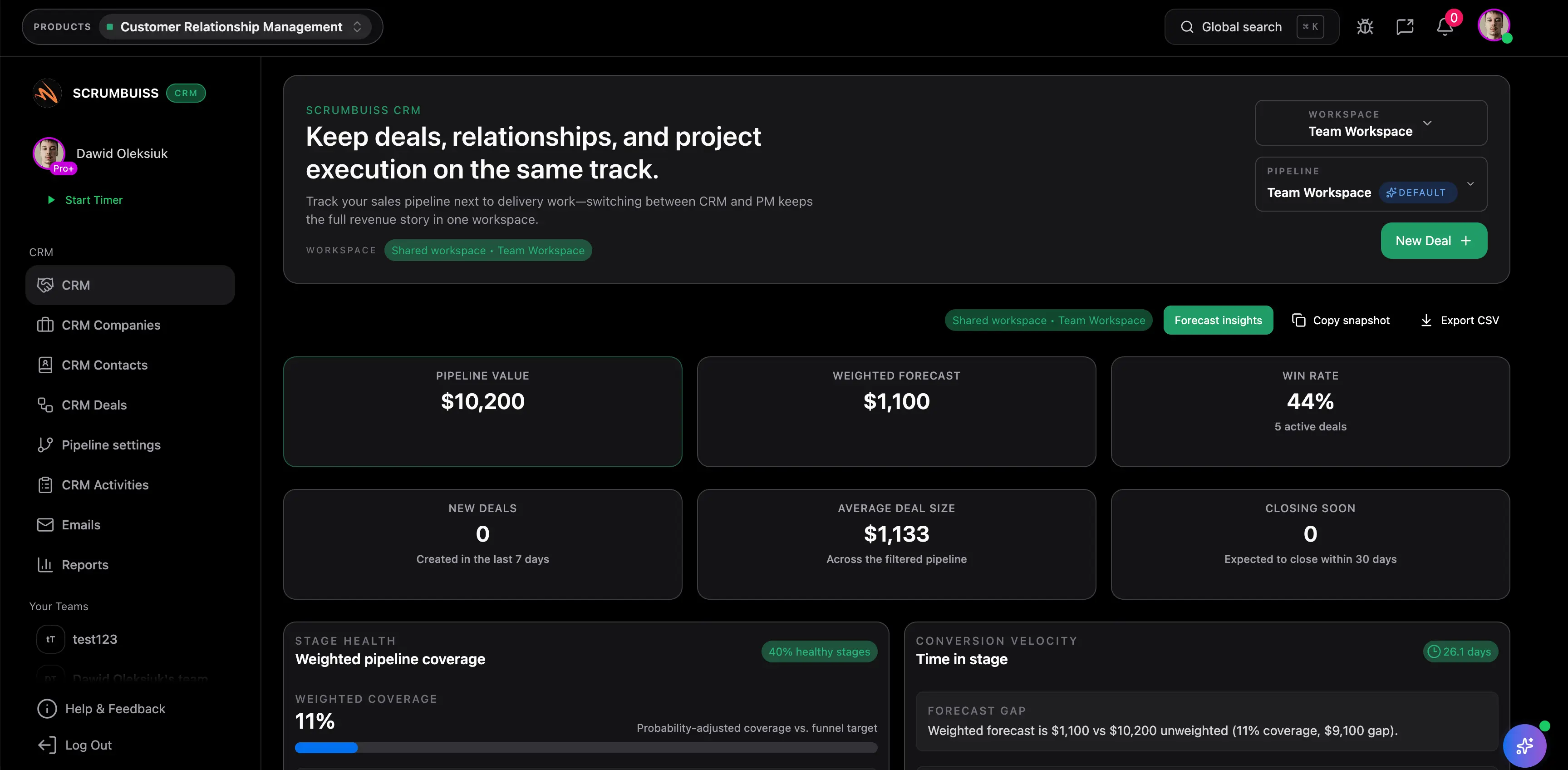
Capture the closed-won story before kickoff starts drifting
Keep the account story, promised scope, stakeholder roles, deadlines, and next owner visible before the first delivery lead has to rebuild them from CRM notes, email, and chat.
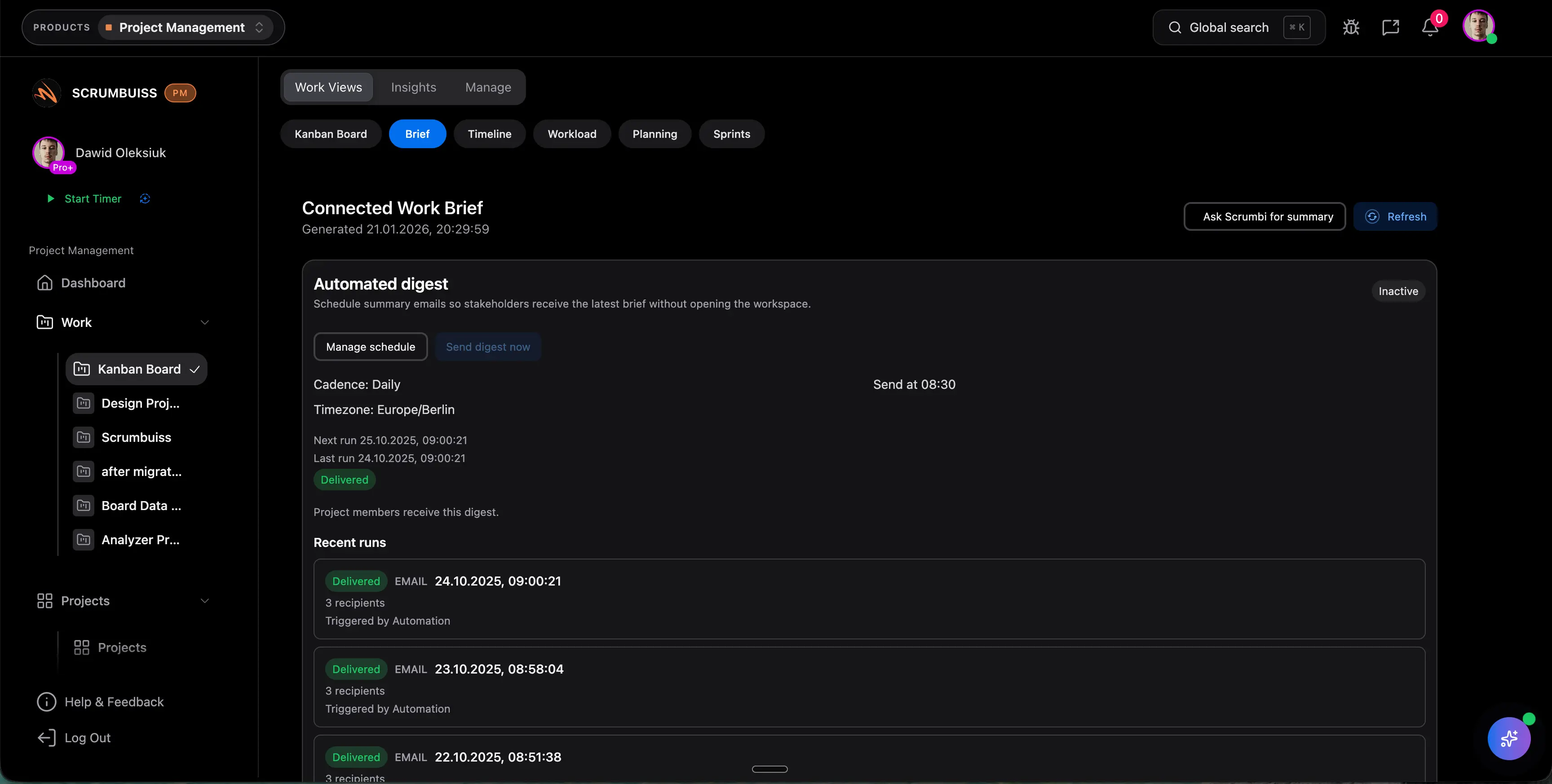
Turn the handoff into one shared kickoff brief and owned plan
Use intake forms, a project brief, and structured ownership so the next team can move from won deal to kickoff without another cleanup loop or discovery meeting.
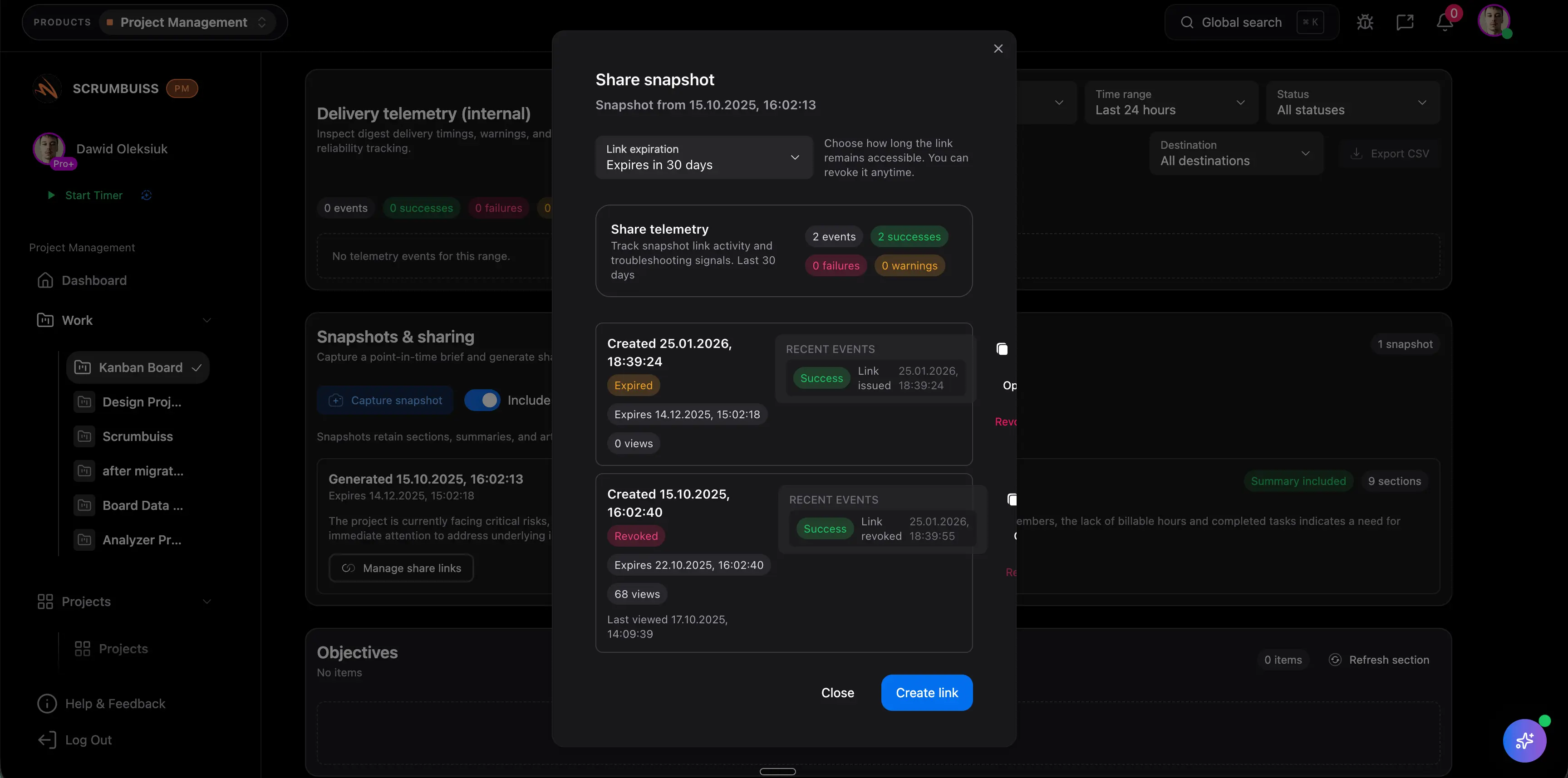
Run files, approvals, and the first status cycle from the same record
Keep files, approvals, tracked effort, and the first client-facing updates connected so the onboarding story still makes sense after kickoff instead of breaking into separate tools.
Potential impact (examples)
The examples below are illustrative and depend on your team, process, and workload.
Reduce kickoff recap work
Keep the original deal context, onboarding inputs, and kickoff brief attached so the next owner does not have to rebuild the same client story from scratch.
Example: Save 1-2 hours per new client or implementation kickoff by reusing captured context instead of rebuilding the handoff across CRM notes, docs, and kickoff agendas.
Shorten time to first owned action
Route the handoff into one owned workflow with forms, reminders, and next steps so onboarding does not stall between the sale, kickoff, and first delivery activity.
Example: Save 30-60 minutes per onboarded client by reducing manual routing, clarification, and follow-up chasing before work can actually start.
Make the first status cycle easier to explain
Keep files, approvals, progress, and tracked effort visible enough that onboarding leads can explain the current state without another spreadsheet, slide deck, or approval recap.
Example: Save 30-60 minutes per week for onboarding or delivery leads by turning live workflow data into faster client-ready updates after kickoff.
Setup checklist
A practical checklist to implement this workflow inside Scrumbuiss.
- ✓ Pilot one real client onboarding flow with a recently closed-won deal or an active implementation handoff.
- ✓ Define the exact context that must survive the handoff: contacts, stakeholder roles, promised scope, files, deadlines, approvals, next owner, and first milestone.
- ✓ Use structured intake for the details the team usually loses before kickoff instead of relying on recap notes and side docs.
- ✓ Build one kickoff brief that the next owner can actually run from without another discovery meeting.
- ✓ Attach working files, approval steps, and the first owned delivery tasks to the same onboarding record.
- ✓ Decide which reminders, routing rules, and follow-up steps should be automated during the pilot and which should stay manual.
- ✓ Run one full kickoff plus first-status-update cycle inside the pilot and judge whether the team still needs a second tracker, recap sheet, or cleanup meeting.
ROI example
A simple way to think about profitability is saved time value (or recovered billable time) minus software cost.
Illustrative calculation (USD)
- Team size: 6
- Hours saved per person per week: 0.7
- Blended hourly rate: $75 per hour
Estimated saved time: 4.2 hours/week
Estimated value: $315 per week (~$1,364 per month)
Illustrative example only. This is not a guarantee or customer result. Use one live closed-won handoff and kickoff cycle to estimate your own saved time before standardizing.
FAQ
What is client onboarding software? +
Client onboarding software helps teams move from a sale or signed engagement into a structured kickoff and first delivery workflow. The useful version does more than collect forms. It keeps contacts, scope, files, approvals, next steps, and status visible enough that the next team can start work without another cleanup loop or recap meeting.
How is client onboarding software different from a CRM or a project management tool on its own? +
A CRM often owns the deal before kickoff, and a project management tool often owns the work after kickoff. Client onboarding software matters in the gap between those two moments. It should keep the handoff from sales into kickoff readable enough that the account story, onboarding inputs, files, approvals, and first actions do not need to be rebuilt manually.
When should I evaluate client portal software instead? +
Use client portal software when secure external access, branded client workspaces, guest permissions, and document-sharing-first collaboration are the primary buying requirements. If the bigger problem is the internal handoff from CRM into kickoff, files, approvals, and early delivery follow-through, this onboarding workflow is usually the stronger fit. For that adjacent decision, use the Client Portal buyer guide.
Can Scrumbuiss share onboarding context externally without exposing the full workspace? +
Yes. Teams can share specific brief and status outputs so clients or stakeholders can review the onboarding context without learning the full internal workspace. If your main requirement is a dedicated secure client portal, validate that separately through the Client Portal path during the pilot.
What should a live client onboarding pilot prove? +
A live pilot should prove that one real client can move from closed-won deal into kickoff with cleaner ownership, less duplicate briefing work, clearer files and approvals, and faster first-status reporting. If the team still needs another recap meeting or another side tracker to start cleanly, the workflow is not connected enough yet.
When is client project management software the better page to evaluate? +
Use client project management software when onboarding is only the first phase and the bigger decision is how files, approvals, tracked effort, workload, and client-visible status should run through ongoing delivery after kickoff. That is a broader post-kickoff operating-model question than this page.
Does Scrumbuiss replace every CRM, portal, or onboarding platform? +
Not always. Scrumbuiss is strongest when client onboarding should stay connected to CRM handoff, kickoff planning, files, approvals, time visibility, and early delivery follow-up. Teams that need a deeper standalone CRM, a more specialized secure onboarding portal, or a broader agency delivery suite should validate those requirements directly in a live pilot.
Supporting links
Explore the supporting pages that back up this workflow and help explain the full delivery stack.
Related products
Related templates
Client handoff template
Download a free client handoff template for sales-to-delivery handoff, client onboarding, kickoff readiness, stakeholders, scope, files, risks, and next actions.
Sales pipeline template
Download a free sales pipeline template for lead management, deal stages, follow-up dates, probability, next steps, and sales-to-delivery handoff readiness.
Project charter template
Download a free project charter template for project goals, scope, stakeholders, assumptions, risks, milestones, success criteria, and approval readiness.
Stakeholder matrix template
Download a free stakeholder matrix template for stakeholder mapping, influence, interest, decision rights, communication cadence, owners, and next actions.
Scope of work template
Download a free scope of work template with example deliverables, exclusions, acceptance criteria, milestones, assumptions, and approval checkpoints.
Project development plan template Excel
Download a free project development plan template for Excel with phases, milestones, owners, dependencies, risks, status fields, Gantt chart inputs, and deliverable tracking for project teams.
Meeting agenda template
Download a free meeting agenda template for project meetings, kickoff reviews, decisions, action items, owners, risks, and follow-up summaries.
Project status report template
Download a free project status report template with progress, milestones, blockers, risks, decisions, next steps, and stakeholder update fields.
Project brief template
Download a free project brief template with a filled example, one-page outline, and practical checklist for aligning scope, stakeholders, milestones, and handoffs.