Client Project Management Software for Agencies
Client project management software should do more than keep a task board moving. Agencies need one workflow that carries new requests into kickoff, keeps files and approvals readable during delivery, tracks time and workload in context, and gives clients a current status view without rebuilding the story in separate tools.
Reviewed on March 20, 2026
A practical workflow guide, illustrated with real Scrumbuiss screenshots. For real customer quotes, visit Customers .
How we evaluated client project management software
Reviewed on March 20, 2026. This buyer guide compares one agency workflow: how new client work moves from request and kickoff into live delivery, files, approvals, time tracking, workload review, and client-visible status without splintering across several systems.
- We reviewed how Scrumbuiss supports that workflow across Client Portal, Project Intake, CRM, Project Brief, Files, Time Tracking, Workload Capacity, and the agencies and client-onboarding use cases.
- We compared that against the official client-work and agency-operation positioning published by Teamwork, ClickUp, Wrike, and Productive.
- We prioritized people-first buyer intent: what agencies need to run client delivery cleanly every week, where board-only setups create handoff gaps, and what to validate before standardizing on a workflow.
At a glance
Scrumbuiss is built for agencies that want one client-delivery workflow, not a separate board for every handoff. The page is strongest when the request, brief, files, approvals, time, workload, and client-visible status stay tied together.
What Scrumbuiss is
Client project management software for agencies that keeps intake, briefs, files, approvals, time tracking, workload, and client-visible status in one operating flow.
Who it fits now
Agencies and client-service teams that already need to run live delivery, share current status, and keep context attached to one project record.
What to validate before rollout
Confirm whether you need deeper profitability reporting or a formal client change-request system before replacing a broader agency-ops stack.
What is shipped today
Strong fit now / Validate if you need
Strong fit now
- One workflow from intake to delivery status
- A client-facing view that keeps current work visible
- Teams that want briefs, files, approvals, and time close together
- Delivery leads who need a demo-first evaluation before rollout
Validate if you need
- Deep profitability reporting for agency finance teams
- A structured client change-request workflow
- A broader agency-operations platform before delivery workflow
Capability matrix
The matrix below keeps the claim boundaries explicit so the page does not overstate what is already live in the app.
| Capability | Status | Notes |
|---|---|---|
| Client intake | Shipped now | Structured intake is available today. |
| Project brief continuity | Shipped now | Brief context can stay attached to delivery work. |
| Files | Shipped now | Files are available in the delivery workflow. |
| Approvals | Shipped now | Approval steps are already part of the flow. |
| Forms | Shipped now | Structured forms are available for intake and follow-up. |
| Time tracking | Shipped now | Tracked effort is available in the product. |
| Workload review | Shipped now | Workload visibility is already part of the app. |
| Budget vs actual | Shipped now | Budget tracking is available today. |
| Client-visible status | Partial today | Status sharing exists, but the stable publication model still needs deeper client-hub work. |
| Profitability | Planned next | This needs the broader finance phase before the page can market it confidently. |
| Client change requests | Planned next | A first-class request flow is still to be built. |
Client project management software comparison
The practical decision is not which workspace can store client tasks. It is which workflow keeps requests, approvals, files, time, workload, and client-ready status readable enough that the agency does not rebuild the same story every week.
| Platform | Best fit | Main tradeoff | Where Scrumbuiss is stronger |
|---|---|---|---|
| Scrumbuiss | Agencies that want one operating path from intake and kickoff through delivery, files, time tracking, workload review, and client-visible status. | It is newer than the largest agency and work-management platforms, so teams should validate the workflow with one live client account and one real reporting cycle before rolling it out broadly. | Keeps intake, briefs, files, client approvals, tracked effort, and delivery status closer together instead of splitting them across separate client-work layers. |
| Teamwork | Client-service teams that prioritize agency delivery, time, budgets, profitability, and broad account operations inside an agency-focused platform. | Buyers should still validate how much kickoff structure, file continuity, and client-facing workflow they want tied directly to the same operating record. | Scrumbuiss is stronger when the shortlist prioritizes a tighter client-delivery workflow connecting requests, briefs, files, time, and status with less platform sprawl. |
| ClickUp | Teams that want a highly configurable all-in-one workspace for client projects, approvals, dashboards, and templated delivery flows. | The flexibility can shift more of the workflow design burden onto the agency once client reporting, workload, and file handoffs need a clearer default model. | Scrumbuiss is stronger when agencies want a more opinionated client-delivery path that stays readable from intake through delivery reviews. |
| Wrike | Agencies and service teams that need broad project coordination, reporting, and client-work visibility in a larger work-management environment. | The broader workspace can be a heavier fit when the real requirement is a clean operating layer for kickoff, files, time, workload, and client updates. | Scrumbuiss is stronger when the team wants a tighter route from client request to owned delivery workflow without as much workspace design overhead. |
| Productive | Agencies that prioritize PSA-style operations, including resourcing, financial control, and broader agency administration around client work. | Teams should validate whether they need a broader agency-operations platform today or a more focused client-delivery workflow first. | Scrumbuiss is stronger when the main buying need is delivery continuity across intake, briefs, files, time, workload, and client-facing progress instead of a finance-led agency stack. |
This is a fit-and-tradeoff view based on public product positioning and visible workflow coverage, not a feature-parity procurement sheet.
How it works
A practical workflow structure you can replicate in your own workspace.
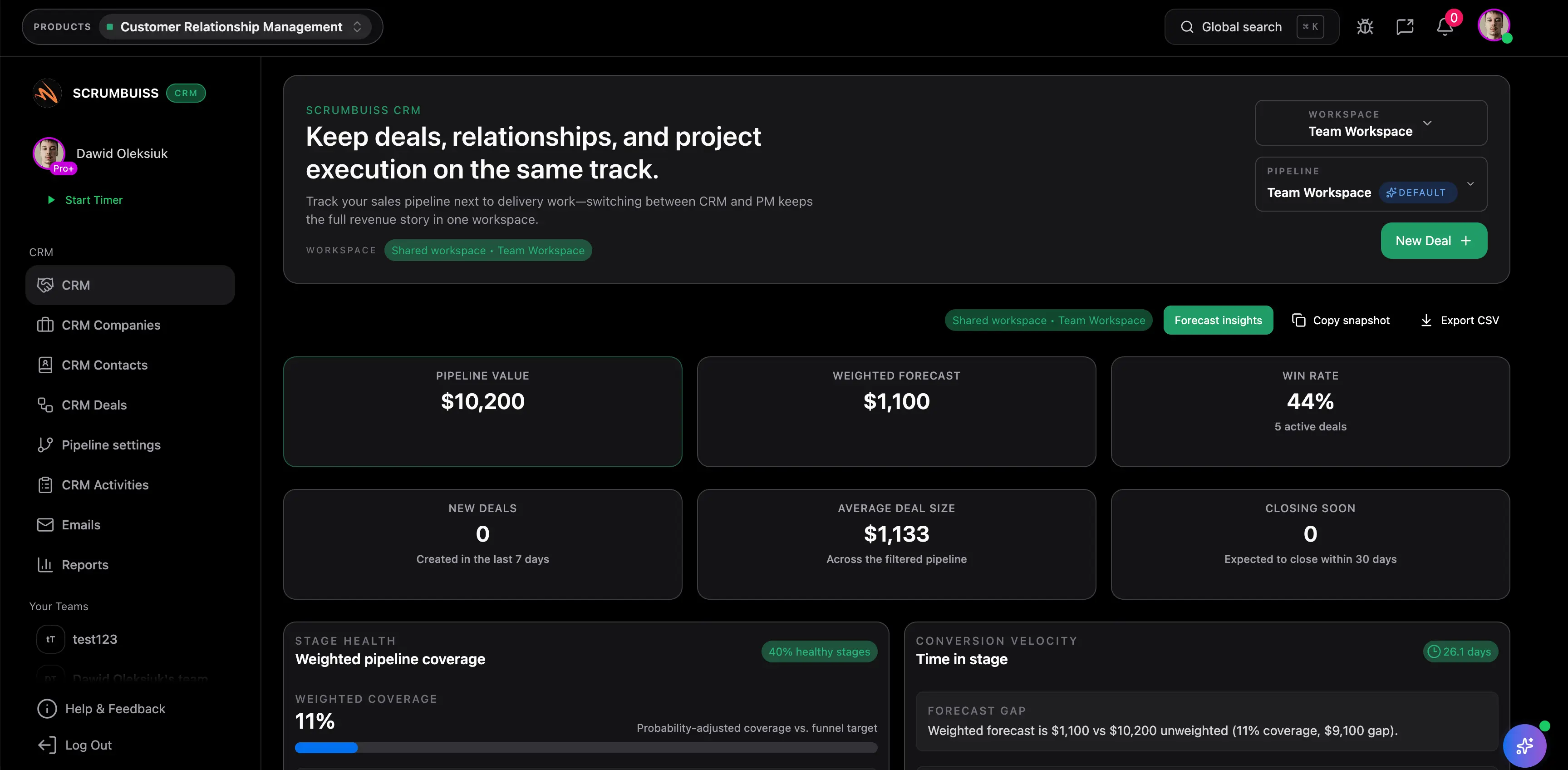
Capture the request and kickoff context before delivery starts drifting
Keep the client ask, scope, stakeholders, files, and next owner attached to one record before the work becomes another cleanup loop.
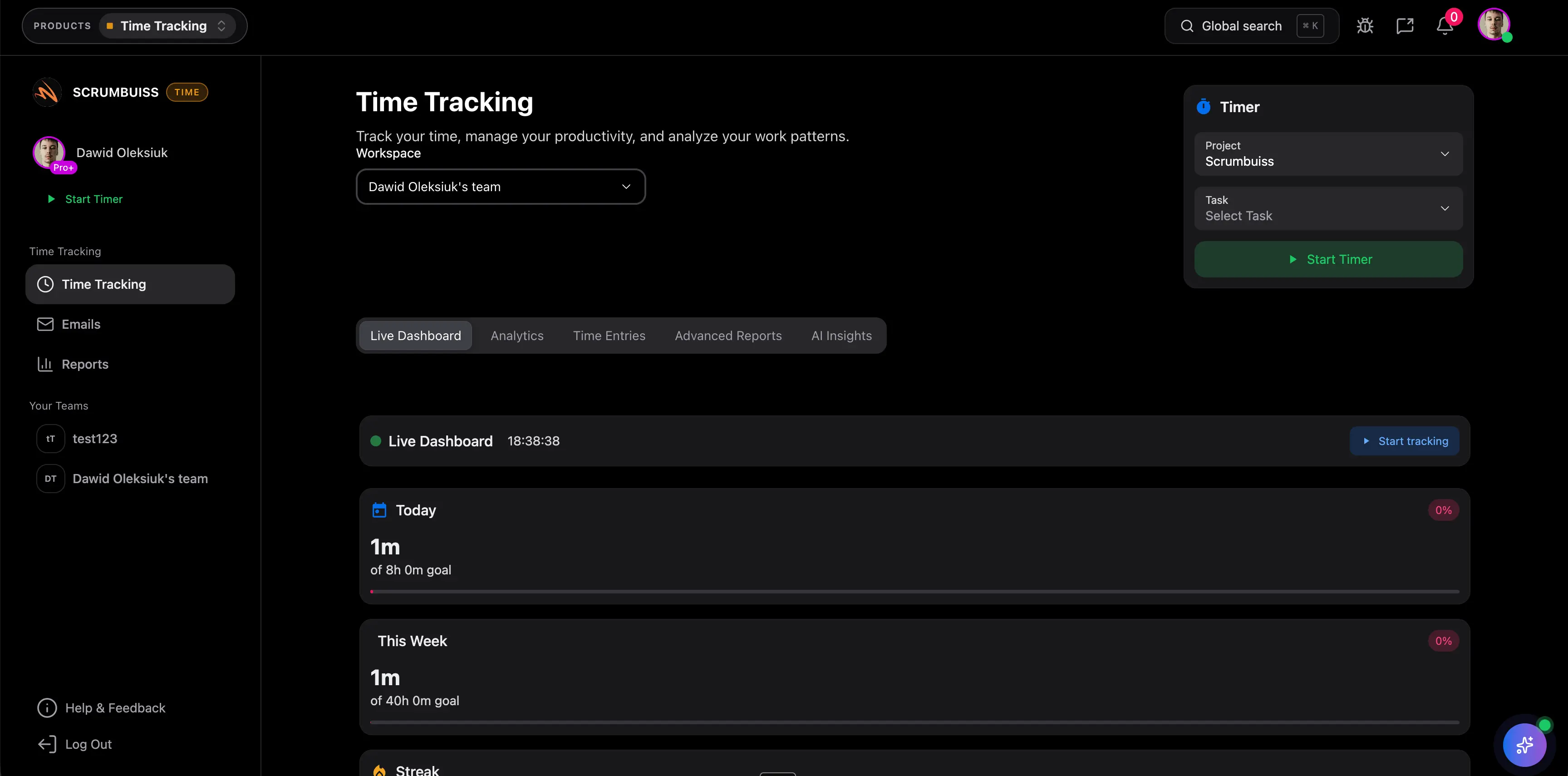
Run delivery with files, approvals, time, and workload visible together
Keep execution, approvals, tracked effort, and overload risk in the same operating layer so the team can act before client work slips.
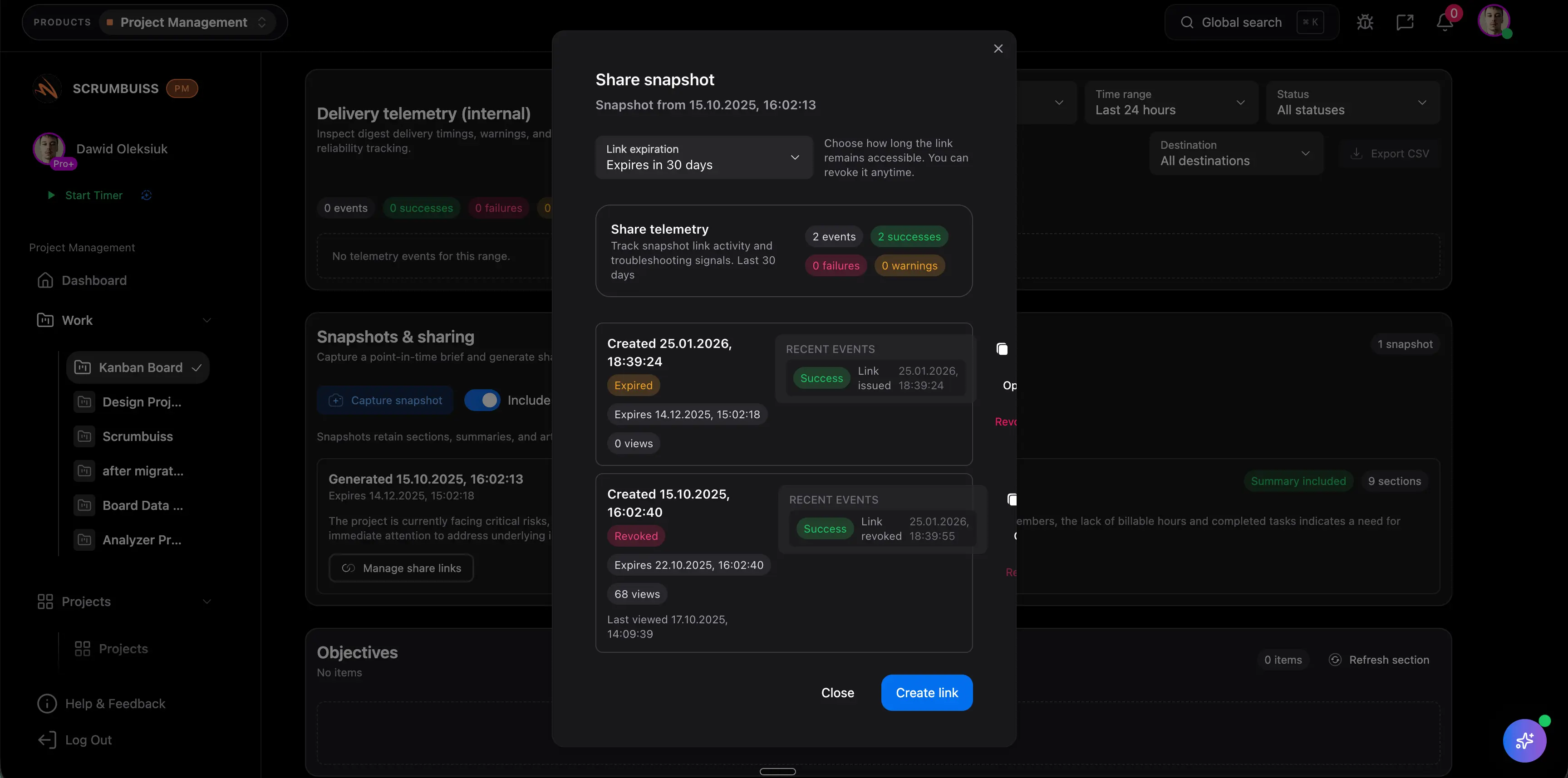
Share progress and next steps without rebuilding a separate client narrative
Use client-visible status, briefs, files, and current delivery context to produce clearer updates with less manual status reconstruction.
ROI example
A simple way to think about profitability is saved time value (or recovered billable time) minus software cost.
Illustrative calculation (USD)
- Team size: 8
- Hours saved per person per week: 0.6
- Blended hourly rate: $85/hour
Estimated saved time: 4.8 hours/week
Estimated value: $408/week (~$1,767/month)
Illustrative example only. This is not a guarantee or customer result. Subtract your software costs to estimate net ROI.
FAQ
What is client project management software? +
Client project management software helps agencies run client delivery from the first request or kickoff through active execution, approvals, files, tracked effort, and current status updates. The useful version does more than organize tasks. It keeps the client-facing story connected to the internal workflow that actually moves the work.
How is client project management software different from agency management software? +
Client project management software is narrower and more delivery-focused. It centers on how client work is requested, planned, delivered, and reported. Agency management software is usually broader and may include staffing, profitability, finance, and wider operational administration. Teams often need to decide which layer matters first.
When is a portal-first tool a better fit than Scrumbuiss? +
A portal-first tool can fit better when the main buying requirement is a more standalone branded client experience with deeper external administration. Scrumbuiss is stronger when the bigger problem is keeping intake, briefs, files, time, workload, and client-visible progress attached to one delivery workflow after kickoff.
Does client project management software need built-in time tracking? +
If billable visibility, scope control, staffing realism, or client reporting matter, keeping time close to delivery work is usually the cleaner setup. The key is not only logging hours. It is whether those hours improve the next staffing, estimate, or status decision.
What should a live client project management pilot prove? +
A useful pilot should prove that one real client workflow can move from intake to kickoff, delivery, approvals, tracked effort, and status reporting with less reconstruction. If the team still needs a second spreadsheet, a second file system, or a second status tracker, the workflow is not connected enough yet.
Does Scrumbuiss replace every PSA or agency-operations platform? +
Not always. Scrumbuiss is strongest when the immediate buying need is a cleaner client-delivery workflow. Teams that need deeper budget-versus-actual control, profitability management, or more formal client change-request administration should validate those broader requirements directly during evaluation.
Secondary links
Explore the supporting pages that back up this workflow and help explain the full delivery stack.
Related products
Project delivery
Plan, execute, and ship with Kanban, sprints, timelines, workload planning, and dashboards.
CRM
Manage contacts, companies, deals, and pipelines — with work connected to delivery.
Time Tracking
Track time with a built-in timer and entries, then report and improve with dashboards.
Files
Store, organize, and share project files — with recents, shared items, and collections.
Related templates
Project brief template
Download a free project brief template with a filled example, one-page outline, and practical checklist for aligning scope, stakeholders, milestones, and handoffs.
Risk register template
Download a free risk register template in CSV format with a filled example, simple 1 to 5 scoring, owners, trigger signals, and a weekly review cadence for project risk tracking.